





Solar generators & portable power stations
Compare battery capacity in watt-hours (Wh), continuous AC output, surge output, charging inputs and weight. Check the package contents: a power station listing does not necessarily include solar panels.
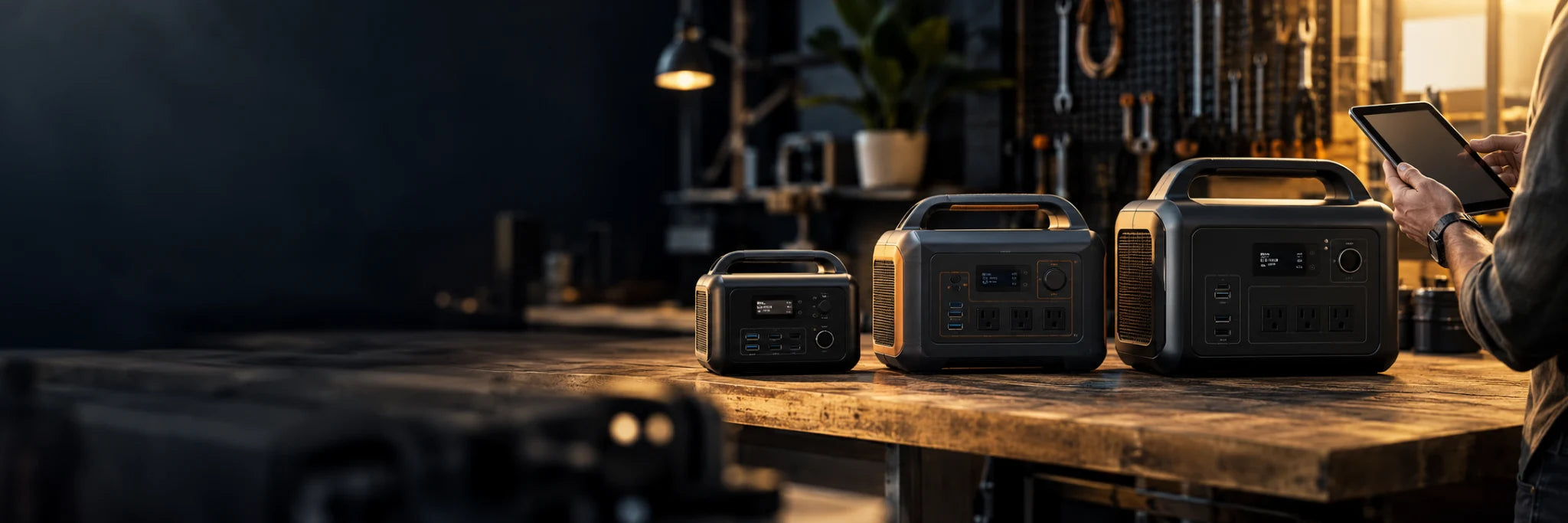
The comparison workspace
Find the right power setup. Compare prices, capacity, output and published specifications for portable power stations, solar panels, batteries and inverters.
Build your comparisonA clearer way to choose
Building a system for home backup, an RV or off-grid travel? Choose a product category, add up to 4 models, and compare their listed details side by side.
01 / Find your contenders
This workspace includes products from our comparison collections. Can’t find a model? Search the store or ask us for help.
02 / Your shortlist
Choose up to 4 products in the same category.
03 / The details that matter
Add two products to see how they compare.
Add products above. We’ll line up their prices and published specifications here.
Prices and availability can change. Products with options may show a starting price; choose your configuration on the product page. Specifications are the listed product details. “Not listed” means data is unavailable, not that a feature is absent. Matching categories do not guarantee electrical compatibility.
Loading the comparison workspace…
A starting point for your shortlist
The Jackery Explorer 1000 v2, Jackery Explorer 1500 v2 and PECRON F3000LFP offer different capacity and output levels. Use their published specifications below to begin your comparison, then open the full tool for charging inputs, dimensions and other details.
| Published detail | Jackery Explorer 1000 V2 Portable Power Station - 1070Wh Capacity | Jackery Explorer 1500 v2 Portable Power Station |
|---|---|---|
| Current price | $499.00Available | $759.00Available |
| Battery capacity | 1070 Wh | 1536 Wh |
| AC output / rated power | 120 V, 15 A; 1,500 W maximum per outlet and 1,500 W total across three outlets | 2,000 W maximum per outlet and 2,000 W total across three AC outlets |
| Product weight | Approximately 23.8 lb (10.8 kg) | Approximately 32.0 lb (14.5 kg) |
Prices and availability update with the product listings. Specifications refer to the listed model; check the product page for your configuration and included components. A larger battery does not by itself establish appliance compatibility.
Compare these models in detailCompare two larger backup stations
Both standalone US models can supply 120V and 240V power, but their storage, AC output and solar-input paths differ. Use the same appliance list and backup duration for both, then check the exact outlet, transfer-equipment and charging requirements before choosing.
| Published detail | Anker SOLIX F3800 Plus | Jackery Explorer 5000 Plus |
|---|---|---|
| Standalone battery capacity | 3,840Wh | 5,040Wh |
| Maximum AC output | 6,000W | 7,200W |
| Solar input | Up to 3,200W total across two 1,600W inputs | Up to 4,000W high-voltage PV input; separate low-voltage DC8020 inputs up to 1,200W combined |
| Current listing price | $2,599.99Available | $3,149.00Available |
Specifications come from the Anker F3800 Plus US product page and Jackery Explorer 5000 Plus model information. Solar ratings refer to different input circuits; do not combine or swap voltage ranges between them. Prices and availability come from the linked Grid Getaway listings. Neither standalone listing automatically includes panels, expansion batteries or transfer equipment.
Want a recommendation based on your actual refrigerator, well pump, HVAC or other loads? Estimate storage and output with the Power Planner, then compare the exact models and selected packages in the tool above.
Make the specifications useful
Start with what you need to power, how long it must run and how you will recharge. Compare products within the same category, then check how the selected components work together.
Compare battery capacity in watt-hours (Wh), continuous AC output, surge output, charging inputs and weight. Check the package contents: a power station listing does not necessarily include solar panels.
Compare rated watts, open-circuit voltage (Voc), current, dimensions and portable or fixed mounting format. Match the panel’s electrical specifications and connectors to the exact power station or charge controller.
Compare voltage, energy capacity, chemistry, charge and discharge limits, and installation format. An expansion battery must be approved for the specific station; matching watt-hours alone does not establish compatibility.
Compare battery-side voltage, continuous and surge output, AC output voltage and charging features. Check whether the unit includes solar MPPT charging or requires a separate charge controller.
Compare supported battery voltage and chemistry, charging current and PV input limits. Use the exact controller manual to check the proposed solar array, including its open-circuit voltage.
Match battery chemistry and voltage first. Then compare charging current, charge profiles and input source, including whether the charger is intended for AC power or vehicle charging.
Check connector type, polarity, electrical ratings, wire gauge and cable length. Confirm the connection requirements of both devices rather than choosing an adapter by appearance alone.
Watts (W) describe power; watt-hours (Wh) describe stored energy. Check continuous output against the appliances you want to run, then compare capacity for runtime. Actual runtime also depends on the load, conversion losses and operating conditions.
A station-only listing, a solar generator kit and a bundle with expansion batteries can have very different prices. Check the exact model generation, selected option, panel quantity, cables and other included components before deciding.
“Not listed” means the specification is unavailable in the product listing. It does not mean the feature is absent. Open the product page for the full details or ask Grid Getaway for help comparing your shortlist.