







The lights go out, the house starts cooling down, and you remember the space heater in the closet. A portable power station sounds like an easy way to keep it running. Before you buy one, though, I want to help you answer the question that matters most: will it keep you warm long enough to be useful?
Yes, a suitably rated solar generator can supply the electricity a compatible space heater needs. But electric resistance heat uses a lot of energy, so battery runtime can be surprisingly short. In the example below, a 2,000Wh battery runs a 1,500W heater continuously for about an hour, after allowing for losses and a small reserve. That is an estimate, not a product test.
There is also a compatibility check before any calculation: follow both manufacturers’ instructions. If your heater requires a wall outlet, do not assume a power station is an approved substitute. Once that is settled, we can work through the numbers without turning this into an electrical engineering class.
First, tell me what you want the heater to do
Warming your feet while you sit in one room is a different job from keeping a house comfortable through a winter outage. I would start there, before comparing power stations.
Imagine you want a little extra warmth for an hour while you wait for the power to return. A battery may have a useful role in that plan. Now imagine you need steady heat for eight hours, with a refrigerator, lights, and phones depending on the same battery. That is a much larger energy problem.
Write down the space you want to warm, the heater setting you expect to use, and how long you need it. Add the other essentials you want to keep running. Even rough answers will help you avoid spending money on a power station that handles the heater perfectly but runs out sooner than you expected.
If you are still building that household list, our guide to choosing a solar generator for home backup walks you through it.
Two numbers tell us two different things
The large numbers on a power station can look interchangeable when you are new to this. They are not. Here is the distinction I want you to remember:
- Watts, or W, describe power. Does the station, its outlet, and the operating mode support the heater’s electrical demand?
- Watt-hours, or Wh, describe stored energy. How much energy does the battery have available before it needs charging?
A 3,000W output rating does not tell you that a heater will run for three hours. It tells you about the station’s power capability. Runtime comes from battery capacity and how quickly your appliances use it.
How long will it last?
I find it easiest to picture two separate checks. First, the heater has to fit within the electrical limits. Then we see whether the battery has enough energy for the time you want. Passing the first check does not automatically pass the second.
Find the heater’s real demand before choosing a battery
Look at your heater’s label and manual. Find its voltage, wattage, and the settings you actually plan to use. A heater might offer a 750W low setting and a 1,500W high setting, but yours may be different. Use its numbers, not a generic description of a ceramic or oil-filled heater.
For a 1,500W heater, the station needs sufficient continuous AC output at the correct voltage, and the specific outlet must support the load. A short surge rating is not a continuous heating allowance. Add any other appliances that will operate at the same time, too.
Then check the mode you intend to use. A station running from its battery may have different limits from the same station connected to household AC power. We will come back to that detail because it can change the answer even when the headline output looks generous.
I would also read the heater’s power-source instructions before shopping. An electrically capable battery is only part of compatibility; the heater and power station must both permit the arrangement. That small amount of homework is more useful than buying from the biggest number on a listing.
How long will a solar generator run a space heater?
Let’s work with a hypothetical 2,000Wh battery and three continuous heater loads. These are calculation examples, not measured runtimes for a Jackery model or any other product.
For this example, we start fully charged, keep 10% of the battery in reserve, assume 90% efficiency when converting battery energy to AC electricity, and allow another 20W for the station’s own continuous consumption. Nothing else is plugged in, and no solar energy is coming in.
Those assumptions leave 1,800Wh to use before the reserve. The two percentages do different jobs: the reserve leaves some energy untouched, while conversion efficiency accounts for energy lost delivering AC power.
the battery faster.
| Heater draw | Estimated runtime | What to keep in mind |
|---|---|---|
| 500W | About 3 hours 8 minutes | Less heating power than the higher settings |
| 750W | About 2 hours 7 minutes | A middle ground if this setting suits your space |
| 1,500W | About 1 hour 4 minutes | A substantial load on a portable battery |
The calculation is: runtime = (battery Wh × 0.90) ÷ (heater W ÷ 0.90 + 20W). The first 0.90 represents the usable portion after our reserve; the second represents our assumed conversion efficiency.
Your actual result will depend on the station’s measured efficiency and consumption, battery condition, temperature, settings, and the heater’s behavior. I would use this table to understand the scale of the job, then check the exact equipment and leave room for uncertainty.
The main takeaway is simple: a 1,500W heater can consume a portable battery’s energy much faster than you might expect. A high output rating does not change that energy demand.
What if you want four hours of heat?
Now let’s work backward from the result you want. A 1,500W heater running continuously for four hours uses 6,000Wh of AC energy. That is the energy delivered to the heater, before allowing for the battery system’s losses.
Using the same assumptions as above, we divide 6,000Wh by 0.90, add 80Wh for four hours of station consumption, and account for our 10% reserve. The result is roughly 7,500Wh, or 7.5kWh, of nominal battery capacity.
That is a substantial battery system for one appliance. It also does not tell us what temperature your room will reach. A drafty room on a very cold day may need more heat than that heater can provide, regardless of how long the battery lasts.
This is where I would pause before adding a bigger system to your cart. If short, supervised heating is the goal, the tradeoff may make sense. If the goal is dependable heat throughout a long winter outage, it is worth considering the home’s broader heating and backup plan first.
Will a lower setting or thermostat make it last longer?
A lower wattage setting can extend runtime because it reduces the rate of energy use. But it also provides less heating power. A 500W setting is not a trick that gives you the same continuous heat as 1,500W while using one-third of the electricity.
A thermostat can help when the room reaches the temperature you selected and the heating element switches off for part of the time. The average draw then falls. How often that happens depends on outdoor temperature, insulation, drafts, room size, and your thermostat setting.
I would not assume that a heater will run only half the time during the outage you are preparing for. In a cold room, it may stay on continuously. Start with that demanding case, then use actual measurements under representative conditions to refine your plan.
Also, an average load is not an outlet rating. A 1,500W heater that cycles on and off still needs support for its full operating demand whenever the element turns on. Thermostat cycling cannot make an undersized power station suitable.
Check this before using the heater while the station charges
This is an easy detail to miss: a power station’s large battery-powered output rating may not apply when it is passing electricity through from a wall outlet.
For example, the US manuals for the Jackery Explorer 2000 Plus and Explorer 5000 Plus list a 12A maximum in the relevant 120V AC bypass mode. At 120V, that is 1,440W. A 1,500W heater exceeds that limit before you add another appliance.
Those products have other capabilities and operating modes, so the important step is to check the exact setup you intend to use. Do not assume that plugging a station into the wall preserves every battery-mode output specification.
Our guide to using a solar generator while charging explains why the charging source, operating mode, and manufacturer’s limits all matter. For a heater, I would confirm those details before relying on pass-through operation.
How two Jackery power stations fit into the decision
Let’s put familiar products next to the numbers. The Explorer 2000 Plus and Explorer 5000 Plus illustrate the difference between supplying enough power and storing more energy. Neither should be chosen from its output rating alone.
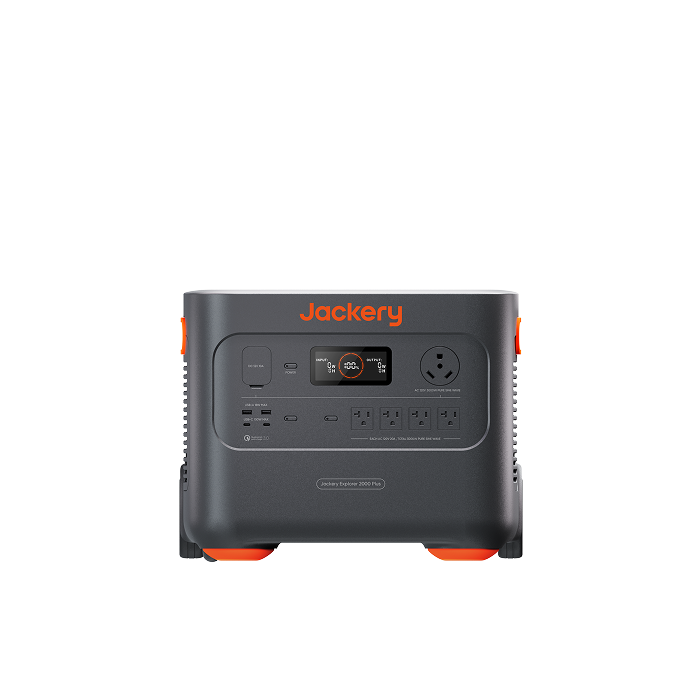
| Power station | Battery capacity | Rated total AC output |
|---|---|---|
| Jackery Explorer 2000 Plus | 2,042.8Wh | 3,000W |
| Jackery Explorer 5000 Plus | 5,040Wh | 7,200W total, with 120V/240V capability |
Total output is not the allowance for every individual outlet. Check the outlet, voltage, mode, combined loads, and both manufacturers’ instructions. In particular, the 120V bypass limitation discussed above is a separate specification from these headline output figures.
The Explorer 2000 Plus sits close to our 2,000Wh example in nominal capacity. That makes the example useful for understanding the scale of a heater load, but it is not a measured runtime claim for this station.
The Explorer 5000 Plus stores considerably more energy. That can be valuable in a broader home-backup plan, especially when you have several priorities. Still, a larger base battery does not make continuous electric heating an all-night solution by default.
Both families offer compatible battery expansion. Added capacity can extend runtime, but it does not remove outlet limits or the heater’s safety requirements. I would choose expansion around your whole outage plan, rather than spending heavily just to keep a portable heater on longer.
Save some battery for the rest of your home
Before giving the heater the entire battery, think about what you would miss if that battery were empty an hour later. Maybe it is the refrigerator, your phone, a few lights, or equipment that helps you keep water out of the basement.
A useful approach is to make two lists: what must keep running, and what would be nice to have. Heating may belong on either list depending on your situation, but the energy budget needs to reflect that choice.
For perspective, our hypothetical 1,500W heater uses about 1,687Wh from the battery in one hour once the stated losses and station consumption are included. That consumes most of the 1,800Wh budget in our example. There is little left for other loads.
If keeping food cold is a priority, work through our refrigerator backup runtime guide before allocating the remaining energy to heat. Your plan will be more useful when the appliances share one realistic budget.
Can solar panels keep up with a space heater?
Solar panels can replace some of the energy you use, but the word “solar” does not make the heater’s demand disappear. What matters is the power actually arriving at the station while the heater runs.
Suppose your panels are delivering 300W and the heater is drawing 1,500W. The incoming power is well below the heater’s demand, even before considering conversion losses. The battery will still lose charge; solar input may slow that decline.
Winter also makes an optimistic recharge plan harder to rely on. Daylight is limited, weather changes, and shade or snow can reduce production. The panel rating is not a promise of continuous output throughout the day.
Check the station’s charging temperature limits, too. A battery that can discharge in cold conditions may have a different permitted charging range. Keep the equipment within the conditions specified by its manufacturer.
Our guide to how many solar panels you need helps you size the charging side. For winter heating, I would plan around conservative production and have an alternative for days when the sun does not cooperate.
Sometimes warming the person is the more useful goal
If you mainly want to stay comfortable while sitting in one room, start with layers, ordinary blankets, and reducing drafts safely. These do not consume your backup battery. Keep every combustible item away from a working heater.
A lower-power heated throw or similar personal-warming product may use less electricity than heating a room, but check its actual rating and instructions. Some products have restrictions on power sources or use. Confirm compatibility with both manufacturers rather than assuming every electric blanket works on an inverter.
If that option fits your situation, our guide to running an electric blanket from a portable power station walks you through the compatibility checks and runtime estimate.
If you have a fuel-burning furnace, backing up its electrical components is a different project from powering an electric resistance heater. The fuel supplies the heat; electricity runs controls and other equipment. That may warrant a separate conversation with a qualified installer about your particular system and connection method.
And if the home cannot stay safely warm, have a plan to move to a heated location. A portable battery should be one part of winter preparation, with a clear alternative when its limits become important.
Keep the heater’s safety rules in the plan
CPSC’s general guidance is to plug portable electric heaters directly into a wall outlet, without an extension cord or power strip. If the heater’s instructions require that connection, do not substitute a power station without confirming an approved arrangement with the manufacturers.
Keep the heater at least three feet from things that can burn, use it on a stable surface as instructed, and turn it off before sleeping or leaving the room. Keep the power station and its ventilation openings away from the heater’s hot airflow. Stop using equipment with damaged cords or signs of overheating.
A longer calculated runtime does not make unattended heating appropriate. I would treat a portable heater as a supervised appliance, even when the battery could keep it running longer.
A few questions you may still have
Can a 1,000W solar generator run a 1,500W space heater?
Not at a continuous 1,500W draw within a 1,000W continuous output limit. A high surge number does not solve that mismatch. A genuinely lower setting may change the electrical demand, but you still need to verify the outlet, operating mode, and manufacturer-approved power source.
Will an oil-filled heater last longer than a ceramic heater?
If both continuously draw the same wattage, their battery energy use will be similar. Their heat delivery and thermostat behavior can differ, which may change average consumption in a particular room. I would compare actual settings and measured use rather than assuming one heater style automatically saves battery power.
Can I run a space heater overnight from a solar generator?
I would not build a sleeping-time heating plan around a portable space heater. Turn it off before sleeping, as the safety guidance advises. For heat through the night, discuss a suitable heating and backup arrangement for your home with a qualified professional.
How big a room will a battery-powered heater warm?
The battery does not determine room coverage. Heater output, insulation, drafts, outdoor temperature, and the temperature you want all matter. A bigger battery can extend operating time; it cannot increase the heat produced by the same heater setting.
Here is how I would make the final decision
Start with the heater’s exact model and approved power source. Check the full operating demand against the station’s outlet and mode limits. Then calculate runtime with losses, a reserve, and the other appliances you need.
If that gives you useful, supervised warmth for the outage you are preparing for, a solar generator may fit the job. If the numbers point to a very large battery for very little heating time, take that as a reason to rethink the heating plan before spending more.
You can contact Grid Getaway with your heater model, desired runtime, and list of other essentials. We can help you compare the electrical requirements and battery capacity, while you confirm the heater’s approved use. The goal is a backup plan you understand and can actually rely on.


