







The lights go out, but the kitchen faucet still works. You fill a glass, check your phone, and figure the water is one less thing to worry about.
Then someone flushes a toilet. A little later, the pressure drops.
If your home gets its water from a well, that is the part of an outage I would want to plan for early. Your pressure tank can give you a little breathing room, but the pump eventually needs electricity to bring more water into the house.
Yes, a solar generator can run a compatible well pump. The right setup must supply the pump’s voltage, handle its startup demand, connect safely to the existing system, and carry enough battery energy for your water use. A big watt-hour number alone cannot answer those questions.
Let’s work through it the way I would if you were trying to keep water flowing at home, starting with the equipment you already own.
Why your water can keep working after the power goes out
In a conventional well system, the pump fills a pressure tank. As you use water, pressure falls. At a set point, the pressure switch calls for the pump to start again.
During an outage, you may still get water from the tank, but the pump cannot refill it without backup power. How much water you have depends partly on where the system was in that cycle when electricity disappeared.
There is an easy detail to miss: the tank’s listed volume is not the amount of water it normally delivers between pump starts.
For example, Amtrol’s Well-X-Trol sizing chart lists its WX-202 as a 20-gallon tank, with 5.4 gallons of drawdown at a 40/60 psi pressure setting. That means water delivered between the 60 psi shutoff and 40 psi restart points. It does not mean a guaranteed 20-gallon outage reserve, or that all water stops precisely at 40 psi.
I would treat that remaining pressure as a short buffer. The backup plan needs to get the pump working again.
Start with your pump, before you shop for a battery
You do not need to become a well technician. You do need enough information to avoid matching expensive equipment by guesswork.
I would gather your installation invoice, pump manual, and photographs of any safely accessible exterior equipment labels. If the pump is underground, its model may be in your installer’s records. There is no reason to pull the pump or open an electrical enclosure to get started.
Here is what I would ask your well contractor or electrician to confirm:
- The pump and motor model: include the horsepower if it is listed.
- The installed voltage and phase: commonly a question of 120V or 240V for a household AC system.
- The control equipment: pressure switch, separate control box, or electronic constant-pressure controller.
- The running and startup requirements: manufacturer data, supplemented by appropriate measurements when needed.
- The existing connection: how the pump circuit can be supplied through approved backup equipment.
Two houses can both have a “one-horsepower well pump” and still need different backup arrangements. The motor, controls, electrical supply, and pumping conditions all matter.
This guide focuses on backing up an existing household AC well pump with a battery power station and optional solar charging. A dedicated solar water-pumping system with a purpose-built DC pump is a different design project.
Check the voltage first: can the station actually supply your pump?
This is the quickest way to rule out the wrong product.
If your installed pump requires 240V, a power station that only supplies 120V cannot run it just because its advertised wattage looks high enough. An ordinary plug adapter does not create the correct voltage.
You might find 115V or 230V on a motor label, while the power station describes 120V or 240V output. Those labels often refer to equipment intended for the corresponding nominal household supply. Have the installer verify the match using the actual manuals.
A dual-voltage label also needs interpretation. It does not mean the pump automatically accepts whichever supply you connect. For example, Pentair’s shallow-well pump manual includes motors configured for a particular voltage. The installed configuration must match the supply; any change belongs with a qualified professional.
Also check the specific output port. A station’s total output rating can be higher than the limit on an individual outlet. Your electrician needs the voltage and current available through the connection that will actually feed the pump.
I would settle this before comparing battery capacities. Extra stored energy cannot fix an incompatible output.
Next, make sure it can start the motor
A well pump asks more of its power source while starting than it does once the motor is running. That brief demand can cause an otherwise powerful-looking station to shut its output off.
Picture a pump that settles into a manageable running load. The power station still has to get it through the first moment of each cycle. It must do that repeatedly, including when other backed-up appliances are already operating.
I would avoid choosing equipment by multiplying the pump’s running watts by a universal number. A “two times” or “three times” shortcut may not describe your motor, controller, or the length of its starting demand.
Franklin Electric’s AIM manual documents motor and control requirements and addresses starting demands in backup-power sizing. Its engine-driven generator tables are useful context, but they are not a compatibility chart for every battery inverter.
Ask the installer to compare the pump’s starting requirements with the station’s supported motor load, output limits, and surge duration. A large peak-watt claim without a stated duration is incomplete information.
Why horsepower and breaker size are not enough
Horsepower describes mechanical output. It is not a direct statement of the electricity the complete pump system takes from your battery.
Similarly, the breaker rating is not a measurement of normal consumption. And multiplying an AC motor’s volts by amps gives apparent power, which may differ from actual watts because of its power factor.
You do not have to calculate all of that yourself. The practical request is simple: “Can you verify what this pump needs to start, what it uses while running, and whether this specific backup system supports both?”
Plan the connection with your electrician
Many household well pumps are hardwired. That makes this a different purchase from buying a power station for a lamp or phone charger.
Your electrician should design the connection, confirm compatible transfer equipment, and preserve the pump’s required controls and protection. The arrangement also needs to prevent backup electricity from feeding into utility lines.
The Electrical Safety Foundation explains why transfer equipment matters when a generator supplies household wiring. Never connect a power station to a wall or dryer outlet with an improvised cord to energize your home.
I would get the installation requirements and cost before ordering the station. That conversation can reveal whether you need an inlet, transfer equipment, wiring work, or a different backup arrangement altogether.
It is also where you decide what happens during an outage. Do you want a manual process you perform at home, or an approved system that transfers automatically? Those are different requirements, and a product’s “UPS” label does not settle every detail.
What a real option looks like: Jackery Explorer 5000 Plus
For a household researching 240V backup, the Jackery Explorer 5000 Plus is an example worth evaluating with the installer.
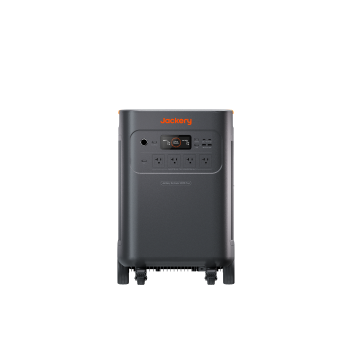
5,040Wh nominal capacity · 120V/240V output
Actual manufacturer image. Compatibility still depends on your pump, connection, and operating mode.
The US owner’s manual lists 5,040Wh of nominal battery capacity and up to 7,200W total AC output, with 120V/240V capability through the appropriate outlets. Those are useful starting points for a comparison, not a promise that it will run every well pump.
Check the charging mode, too
Here is a detail I would want answered before planning around unattended water backup.
Jackery’s support specifications list no output from the 240V ports during simultaneous charging and discharging in its “Split Outlet Mode.” The manual also limits Online UPS operation to its 120V 5-20 outlets.
Have the installer and manufacturer confirm the exact charging and transfer arrangement you intend to use. Do not assume a 240V pump will stay powered through wall charging, an outage, and utility restoration just because the station supports pass-through operation.
That specific mode restriction should not be generalized to every solar-charging arrangement. The connection and operating mode need their own check.
Our guide to using a solar generator while charging explains why that distinction matters beyond well pumps, too.
How long will the battery keep your water running?
Once we know the station can operate your pump, we can work out how much stored energy you need.
The key question is how many minutes the pump actually runs over a day. A 24-hour outage does not automatically mean 24 hours of pumping. In a conventional pressure-tank system, the motor cycles as water is used and the tank refills.
Your household’s daily pumping time depends on water demand and the system’s delivery rate. Long showers, irrigation, livestock watering, leaks, and treatment cycles can change it substantially.
I would ask your contractor how to measure representative pump runtime and electrical consumption safely. A quiet weekday may tell a different story from a weekend with laundry and guests.
A practical example, with the assumptions visible
For this illustration, assume the pump and its controls average 900W during active pumping, including the energy used in those starts. Startup power compatibility has already been checked separately.
We will allow 90% conversion efficiency for delivering that AC energy, plus a separate 50W allowance for the station’s own consumption throughout 24 hours. The conversion allowance here excludes that separately counted operating consumption.
These are planning assumptions, not a measured Jackery runtime test. Actual operating consumption varies by product and mode. This example includes no separate idle controller load, other appliances, or recharging.
| Pump runs per day | Energy delivered to pump | Total battery energy per day |
|---|---|---|
| 15 minutes | 225Wh | 1,450Wh |
| 30 minutes | 450Wh | 1,700Wh |
| 60 minutes | 900Wh | 2,200Wh |
For the middle row, the arithmetic is:
- 900W × 0.5 hour = 450Wh delivered to the pump.
- 450Wh ÷ 0.90 = 500Wh from the battery for pumping and conversion losses.
- 50W × 24 hours = 1,200Wh for the station’s own operation.
- 500Wh + 1,200Wh = 1,700Wh of battery energy per day.
The station uses energy while waiting for the next start.
That example shows why I would not divide a battery’s capacity by the pump’s running watts and call the answer “days of water.” The station may stay awake for hours between pump cycles, and its own consumption can be a major part of the budget.
Under these assumptions, three days require 5,100Wh before a reserve. Keeping 10% of nominal capacity aside increases the planning figure to about 5,700Wh: 5,100Wh divided by 0.90, rounded up.
That is already above a 5,040Wh base battery, even though the pump only runs 30 minutes per day. Different measured consumption could change the result considerably.
Usable capacity, temperature, battery condition, and chosen charge limits also affect the real plan. Add any controller idle demand and other loads before deciding whether an expansion battery is necessary.
For a broader household budget, our home-backup sizing guide walks through combining appliance loads.
Decide what “having water” needs to include
During a short outage, your priority may be drinking water, handwashing, and flushing toilets. For several days, showers and cooking become more important.
I would make that list before choosing a battery. It gives you a realistic target and helps you decide which uses can wait.
Remember that restoring the well pump does not automatically restore every part of your water system:
- Water heating: an electric water heater needs its own substantial power allowance.
- Treatment equipment: UV treatment, dosing pumps, electronic controls, or scheduled regeneration may need electricity or an outage procedure.
- Wastewater equipment: a sewage ejector or septic lift pump, if present, is a separate load.
- Other household essentials: refrigeration and heating equipment share the available output and battery energy if connected.
Check treatment requirements with your water-system professional. Electricity at the pump alone does not establish that the complete treatment system is operating correctly.
If your property also has a sump pump, put it on its own line in the backup plan. Keeping groundwater out of the basement and supplying household water are separate jobs.
Where solar panels fit into the plan
The battery can supply a compatible pump at night. Solar panels replenish stored energy when conditions allow; they do not have to be producing at the exact moment someone turns on a faucet.
For repeated days of backup, I would compare daily battery demand with realistic daily solar energy received. A panel’s watt rating is a power rating, not the watt-hours it will deliver every day.
For example, replacing the illustrative 1,700Wh daily battery use requires enough accepted solar energy to cover that amount plus charging losses. It also requires compatible panels and a charging arrangement that supports the intended pump operation.
Our solar panel sizing guide helps build that estimate. I would also plan for cloudy days with reduced solar input, especially when the same storm may interrupt utility power.
A full battery at the start of an outage gives you a useful buffer. Solar replenishment should be based on conditions you can reasonably expect, with a fallback for longer poor-weather periods.
Test the whole setup before you need it
I would want a supervised commissioning test after installation, while utility power is available and your electrician can address any problems.
The test should confirm more than one successful pump start:
- Normal cycling: the pump starts, restores pressure, and stops through its existing controls.
- Shared loads: the intended combination of appliances works without overloading the backup source.
- Idle behavior: the AC output remains available after long periods without water use.
- Charging and transfer: the approved arrangement behaves as intended during charging, an outage, and utility restoration.
- Battery use: observed consumption supports the outage duration you are planning for.
Idle behavior deserves particular attention. Power-saving settings can turn an output off when the connected load stays low. On the Explorer 5000 Plus, the manual describes an AC energy-saving timeout after 12 hours at 25W or less. A well pump may be off for long stretches, so the installer should configure and verify the appropriate settings.
Keep the operating instructions somewhere another adult in the household can find them. The person who researched the system may not be home when the power goes out.
Common questions about solar generators and well pumps
Can a 2,000W solar generator run a well pump?
Possibly, but that rating alone is insufficient. You still need the correct voltage, adequate starting capability, a compatible connection, and enough energy. A 120V-only station cannot directly supply an installed 240V pump, regardless of unused wattage.
What size solar generator do I need for a half-horsepower or one-horsepower pump?
Start with the exact motor and controller specifications. Horsepower alone cannot establish electrical input or starting demand. Once those requirements are confirmed, choose battery capacity using daily pumping time, station consumption, other loads, and your desired outage duration.
Can it run a deep-well submersible pump?
A suitable system can, but well depth alone does not identify the right power station. The installed pump, motor, controls, and electrical requirements determine compatibility. Ask your well contractor to identify the equipment before ordering backup power.
Does a three-wire pump need three-phase power?
Not necessarily. In residential submersible-pump terminology, a three-wire single-phase motor uses a separate control box. Wire count is not the same as electrical phase. Confirm the motor and matching controls from the manufacturer’s documentation.
Can I add a soft starter to make a smaller station work?
Only consider starting-control changes approved for your exact pump, motor, and controller. Do not assume an accessory intended for a different appliance will work. Your well contractor and equipment manufacturers should verify compatibility before any modification.
My starting point would be your pump’s model number
Keeping water available during an outage is a worthwhile goal. Getting there starts with knowing what your existing system needs.
Confirm voltage and starting requirements, have the connection planned, and then size the battery around your household’s actual water use. Include the quiet hours between pump cycles in that energy budget.
If you would like help narrowing the equipment choices, contact Grid Getaway with your pump model, installed voltage, controller information, and the other appliances you hope to back up. We can use those details to discuss options while your electrician or well contractor verifies installation and pump compatibility.


