







Before I spent a few thousand dollars on backup power, I’d want to know more than whether it could run my refrigerator tonight. I’d want to know what I could reasonably expect from it several years down the road.
That is where shopping for a solar generator can get confusing. One page says “4,000 cycles.” Another says “6,000 cycles.” Somewhere else, there is a ten-year lifespan claim and a much shorter warranty.
You are trying to answer a simpler question: will this still be useful when my family needs it?
A well-chosen solar generator can serve you for many years, but its useful life depends on more than a cycle count. Battery aging, storage conditions, how you use it, and the condition of the rest of the power station all matter.
I would judge longevity by two things together: the manufacturer’s documented ratings and how much backup time your household needs as the battery gets older. Let’s make those numbers easier to use.
First, separate lifespan from runtime
When someone asks how long a solar generator lasts, they can mean two very different things.
- Runtime: how many hours your appliances can run before the battery needs recharging.
- Lifespan: how long the equipment remains useful over years of ownership.
A power station might provide several hours of backup on one charge, then recharge and repeat that job many times. As its battery ages, the amount of energy it holds can gradually decline.
For this guide, we are talking about the portable power station at the center of a solar-generator setup. The solar panels, charging equipment, and battery do not necessarily wear out on the same schedule.
If your immediate question is whether a particular battery will cover tonight’s outage, our home-backup sizing guide is the starting point. Here, I want to help you think beyond that first night.
What does “4,000 cycles to 70% capacity” actually mean?
Read the whole rating, including the percentage at the end.
A rating of 4,000 cycles to 70% capacity describes a battery’s capacity retention after a specified amount of cycling under the manufacturer’s test conditions. The percentage tells you how much of the original capacity remains at that benchmark.
It is not a countdown to the day the unit suddenly stops working. It also does not tell you that the battery stays at its original capacity until cycle 3,999.
For an easy example, imagine a battery that originally holds 2,000 watt-hours, or Wh. At 70% retained capacity, that becomes approximately 1,400Wh on the same capacity basis.
That remaining energy can still be useful. The question is whether it covers the job you bought the station to do.
A full charge and a healthy battery are different measurements
The charge display can still reach 100% after the battery has lost some of its original capacity. It is full relative to what it can currently hold.
Think of a container that has become smaller. You can fill it to the top, but it carries less than it did before. That is why a full charge alone cannot tell you how much backup time an older station will deliver.
Different capacity.
Does plugging it in count as a cycle?
A quick top-up is not automatically equivalent to a complete discharge and recharge.
As a simplified energy-throughput example, using half of a battery’s original capacity today and another half tomorrow adds up to roughly one equivalent full cycle. It does not necessarily equal two full cycles just because you connected the charger twice.
Manufacturers can use particular depths of discharge, temperatures, charging rates, and counting methods for their published tests. That is why I would use this example to understand the idea, then check the rating’s conditions before comparing products.
How many years should you expect?
There is no dependable calendar answer that applies to every solar generator. Modern models can carry ratings for thousands of cycles, but translating those into your household’s years of ownership takes more information.
Here is the tempting shortcut: 4,000 cycles divided by one full cycle every day is about eleven years. The arithmetic is correct. It describes how long that amount of cycling would take.
It does not account for aging while the battery sits, changing temperatures, different loads, or a problem with another component. Using it once a month also does not turn that same rating into centuries of dependable service.
The System Advisor Model’s battery-life documentation distinguishes two mechanisms: cycle aging from charge and discharge use, and calendar aging that occurs with time. Both belong in the conversation.
My practical takeaway is to look for strong documented capacity retention, sensible storage requirements, and support you can use. Then leave enough room in your energy budget that modest capacity loss does not immediately undermine your backup plan.
Read two real product ratings with me
Let’s look at two Jackery models listed in our store. These examples show how to interpret specifications; your appliance requirements and current availability still determine which options make sense.
| Power station | Original rated capacity | Published cycle rating |
|---|---|---|
| Explorer 1000 v2 | 1,070Wh | 4,000 cycles to at least 70% |
| Explorer 1500 v2 | 1,536Wh | 6,000 cycles to at least 70% |
Those figures come from Jackery’s support specifications for the Explorer 1000 v2 and Explorer 1500 v2. Both use lithium iron phosphate batteries, commonly called LiFePO4 or LFP.
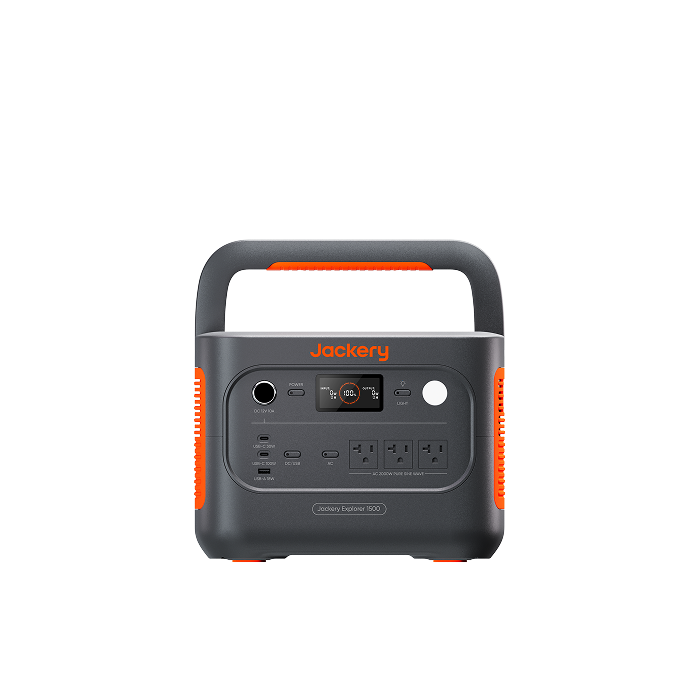
1,536Wh original rated capacity.
Read the cycle count and retained-capacity percentage together when comparing battery specifications.
The 1500 v2 has both a larger original capacity and a higher published cycle count at the same stated retention threshold. That is useful information. It does not establish that the complete unit will last exactly 50% longer in your home.
I would also avoid declaring one brand better because its battery is rated to 70% while another reports cycles to 80%. Those are different endpoints. Compare the retained-capacity threshold and test conditions alongside the headline cycle number.
And watch the chemistry labels: LiFePO4 is a type of lithium-ion battery. NMC is another lithium-ion chemistry. A comparison presented as “LiFePO4 versus lithium-ion” can hide that relationship. The exact model’s documented rating is more useful than the category name alone.
What an aging battery means during an outage
This is the part I would care about most as a homeowner. A battery can remain functional while providing less backup time than your original plan requires.
Let’s use an illustrative 2,000Wh battery and a small group of compatible essentials averaging 72W through the AC outlets. That could represent a hypothetical mix of cycling refrigeration and small electronics; it is not a measured household or product test.
We will assume:
- 90% conversion efficiency for delivering that AC energy.
- 10W of separate station consumption throughout operation, excluded from the conversion allowance above.
- A 10% reserve of the battery’s current full capacity.
- A full charge at the start, no recharging, and unchanged load and efficiency in every comparison.
Battery demand is 72W divided by 0.90, plus 10W: 90W in total. We have already assumed the equipment can support the appliances’ running and startup requirements.
| Retained capacity | Energy above reserve | Illustrative runtime |
|---|---|---|
| 100%: 2,000Wh | 1,800Wh | 20 hours |
| 80%: 1,600Wh | 1,440Wh | 16 hours |
| 70%: 1,400Wh | 1,260Wh | 14 hours |
Less time on battery.
Your backup plan may need to change.
For the last row, 1,400Wh multiplied by 90% leaves 1,260Wh above the reserve. Divide that by the 90W battery demand and you get fourteen hours.
Notice that there are no years attached to those rows. This shows what different capacity levels would mean under fixed assumptions. It does not predict when a particular battery will reach them.
If your goal were eighteen hours, the new-battery example would meet it. The 70% example would fall short, even though the station might still be perfectly useful for a shorter outage or a smaller load.
Under these same assumptions, preserving an eighteen-hour target at 70% retention would require about 2,600Wh of original capacity: 18 × 90 ÷ 0.70 ÷ 0.90, rounded up. That is a planning illustration, not a recommendation to buy a particular size.
Your actual usable energy, temperatures, settings, appliance cycling, and operating losses can differ. Our guide to refrigerator backup runtime helps you build a more relevant estimate for that appliance.
How you use the station changes what matters most
If it mostly waits for emergencies
You may accumulate relatively little cycling. In that case, I would pay close attention to storage, periodic checks, and whether the unit is charged when you need it.
A station forgotten in a hot garage or left depleted for months is not being protected simply because it has barely been used. Calendar aging and the manufacturer’s storage requirements still apply.
Put a reminder on your calendar. When it comes up, check the charge, inspect the outside and cables, and follow the maintenance schedule for your model.
If you use it every day
Cycle life deserves more weight when the battery regularly powers a home office, cabin, or other daily load. Look at how much energy you move through it, how deeply you discharge it, and which operating modes the manufacturer supports.
Also consider your expectations. Using a battery to reduce grid consumption every afternoon and keeping it full for an unexpected evening outage are competing goals. Supported reserve and scheduling settings can help you decide how much energy stays available for backup.
If it travels with you
For camping or RV use, I would include handling and storage in the decision. The power station needs a secure, suitable location, and its cables and ports need protection during transport.
A high cycle rating does not make a product weatherproof or immune to damage. Check the equipment’s actual environmental rating before leaving it where rain, dust, or heat can reach it.
The care habits I would prioritize
Give heat some attention
A battery’s environment affects how it ages. Published research on LFP battery aging found that storage temperature and state of charge affected capacity loss in the cells studied. It is evidence for taking operating conditions seriously, not a lifespan calculator for every portable station.
I would choose a dry, ventilated location within the manual’s limits and keep cooling vents clear. A closed vehicle in summer is a poor place to assume that conditions remain acceptable all day.
Charging, operating, and storage temperature ranges can differ. Some models have particular cold-weather features; others do not. Check your exact unit before charging it in freezing conditions.
Use the storage instructions for your model
There is no single storage percentage or recharge schedule that I would apply to every power station.
For example, the Explorer 1500 v2 manual, model JE-1500D, recommends checking and recharging every three months during storage. It also specifies a periodic full charge-and-discharge cycle at least once every six to twelve months and gives different storage-temperature limits for different durations.
Follow those model-specific instructions, including applicable warranty maintenance requirements. Routine use does not need to become a project where you intentionally empty the battery every time you touch it.
Balance battery care with being ready
If your model offers charge limits or a battery-saving mode, understand what those settings do before relying on them.
A lower charge ceiling may suit a supported everyday routine, but it also leaves less energy available at the beginning of an outage. The capacity printed on the box is not all available if your chosen settings keep part of it unused.
Before a forecast storm, I would check the charge target, output settings, and manufacturer’s readiness instructions. Then I would return to the supported routine that fits normal use.
For the separate question of powering appliances during charging, see our guide to using a solar generator while charging. Pass-through support and long-term storage guidance answer different questions.
A warranty is another number to read carefully
A cycle-life rating, a lifespan claim, and a warranty period describe different things.
The cycle rating concerns capacity retention under test conditions. A lifespan claim describes an expectation under stated assumptions. A warranty defines the covered problems, eligibility, time period, and remedies in its terms.
Jackery’s service policy, for example, addresses defects in materials and workmanship, proof of purchase, exclusions, and warranty-extension requirements. Do not assume a cycle rating is an unconditional capacity warranty.
Before ordering, I would confirm:
- The warranty that applies to the exact model and purchase channel.
- Whether an extension requires registration or other steps.
- Any charging or maintenance requirements that affect coverage.
- How to request service and what the shipping process involves.
- Whether the warranty transfers if the product is sold or gifted.
Keep the receipt, serial number, manual, and registration confirmation together. That small bit of organization can make a future support conversation much easier.
What if the battery still works, but something else fails?
The power station contains more than battery cells. Charging electronics, the inverter that supplies AC power, cooling components, connectors, and controls all contribute to its usefulness.
A battery’s cycle rating does not establish a service life for every one of those parts. This is why I would ask about repair support as well as battery specifications.
Before buying for long-term use, find out whether the manufacturer offers service for the model and how battery-related repairs are handled. Do not assume the internal pack is designed for owner replacement.
An expansion battery is a separate question. On supported systems it can add storage, but it does not restore lost capacity inside the original battery or renew aging electronics. Compatibility must be confirmed for the exact equipment.
The solar panels deserve their own check, too. Their output can change with shade, dirt, damage, connections, and weather. Slower solar charging alone is not proof that the station’s battery has worn out. Our cloudy-day backup guide explains how changing solar input affects the plan.
How I would check an older station before storm season
Start with ordinary operation, following the manual. Check that charging works, the intended outputs operate, and the equipment has no visible damage or persistent warnings.
Then try a familiar, compatible load under comparable conditions. Record the starting charge, enabled outputs, connected appliances, approximate temperature, and how long it runs to your chosen reserve.
That is a practical readiness check, not a laboratory battery-health measurement. Appliance behavior, station settings, and conversion losses can change the result. Avoid inferring a precise health percentage from one short run.
If performance has dropped unexpectedly, look for changed settings or loads and contact support. Do not open the enclosure or bypass protection to investigate a battery problem.
Finally, ask whether the system still meets your needs. A new appliance or a longer outage target can outgrow an otherwise functioning station. That calls for an updated backup plan rather than an assumption that age alone explains everything.
Common questions about solar-generator lifespan
Does a solar generator stop working at its rated cycle count?
No. A rating tied to 70% or 80% capacity describes a retention benchmark under specified conditions. It is not a programmed expiration date. Continued usefulness depends on the equipment’s condition and the backup time you need.
Will occasional use make the battery last forever?
No. Less cycling can reduce one source of wear, but time and storage conditions still matter. Follow the model’s maintenance schedule even when the station spends most of the year waiting for an outage.
Does solar charging make it last longer than wall charging?
The source alone does not establish battery lifespan. What matters includes how the station manages charging, temperatures, charge levels, and overall use. Follow its supported charging methods and avoid assuming slower solar input automatically guarantees longer life.
Can I replace the battery instead of replacing the whole station?
That depends on the model and available manufacturer service. Check before purchasing if repairability matters to you. An integrated battery should not be treated as owner-replaceable unless the manufacturer explicitly provides for that.
Buy for the backup time you want to keep
The most useful lifespan question is whether the system can keep doing its job for your household as it ages.
Read the full cycle rating, allow for reduced capacity, follow the correct care instructions, and understand the warranty. A little planning margin can be more useful than chasing the largest cycle number on a comparison chart.
If you want help choosing around your own needs, contact Grid Getaway with the appliances you want to power, your desired backup duration, and whether you expect daily or occasional use. Those details give us a better starting point for discussing capacity, features, and long-term practicality.


