







“My furnace runs on gas. Why would a power outage stop it?”
You would be forgiven for expecting the heat to keep working when the lights go out. The missing piece is that a modern gas furnace needs electricity as well as fuel. The gas supplies the heat, while electrical components help start the system, control it, and move warm air through your home.
Yes, a compatible solar generator can run a gas furnace during an outage. The right setup needs adequate operating and starting power, enough battery capacity, and an approved electrical connection. Matching wattage alone does not settle every compatibility question.
I would work through those checks before choosing a product. You are trying to keep your home comfortable when it matters, and that deserves a more useful answer than “buy a big battery.” Let’s build that answer around your furnace and the outage you want to prepare for.
First, make sure we are talking about the same heating system
This guide focuses on a residential forced-air gas furnace. Natural gas or propane supplies its fuel, and a blower moves heated air through ducts. Your thermostat might simply say “heat,” so check the equipment model or ask your heating contractor if you are unsure what you have.
An electric resistance furnace and a heat pump are different sizing projects. Their electrical demand includes producing or moving the heat itself. A gas boiler also needs its own assessment because pumps and controls differ from a forced-air furnace. Do not carry a furnace runtime estimate over to another system just because both warm the house.
There is another practical boundary: a battery cannot replace an interrupted gas supply or repair a furnace that already has a fault. Backup electricity helps with a loss of utility power when the rest of the heating system can operate properly.
What does the battery actually power?
Depending on the furnace, electricity serves the blower, combustion-air inducer, ignition equipment, control board, and safety controls. Their activity changes through the heating cycle. That is why the furnace’s electrical draw is not necessarily one steady number from the moment the thermostat calls for heat.
needs both.
Notice that the battery is not supplying all of the home’s heating energy. Fuel still does that job. This is what makes backing up a compatible gas furnace a different proposition from powering a portable electric space heater.
If you are weighing those two approaches, our guide to running a space heater from a solar generator explains the battery demand of resistance heating. Neither approach should be chosen until you know what your home needs.
Gather these details before you shop
I would begin with the furnace model number, its electrical specifications, and the installation manual. Use an accessible label or existing paperwork; leave access to electrical compartments and measurements on hardwired equipment to a qualified technician.
Ask your technician to help you establish:
- Supply requirements: the specified voltage, frequency, and electrical connection.
- Operating demand: the whole furnace’s draw through its heating cycle, including different stages or blower speeds.
- Starting demand: the peak current or power and how long the source must support it.
- Associated equipment: anything else necessary for normal operation, such as a condensate pump.
The large BTU number describes a heating rating, not the electrical watts you should put into a battery calculator. The breaker rating is not a measurement of everyday consumption, either. A furnace on a 15A circuit does not automatically draw 1,800W continuously.
Multiplying volts by amps also does not necessarily give you measured watts for a motor-driven AC load. Let the technician interpret the ratings and measure real power where appropriate. You do not need to master every electrical term; you need reliable numbers for your particular equipment.
Can the power station start and operate your furnace?
Start with output power, measured in watts. The power station must support the furnace’s operating demand and its starting requirements, along with any other appliances sharing the supply.
A surge rating is only useful when it covers the actual startup event. Its duration matters, and a generic rule such as “multiply the running watts by three” is not a substitute for model-specific information. Different motors and controls can behave differently.
Next, match the required voltage and check the particular outlet or connection being used. A station’s total output may be shared across outlets or split between voltage configurations. The largest number in the product name is not necessarily the power available to your furnace.
For example, Carrier’s 59SP5A installation instructions require an alternate supply with a smooth sinusoidal waveform and matching voltage, frequency, and phase. That is a useful reminder to check power quality in your own manual. A “pure sine wave” specification helps answer one question; it does not approve the entire installation.
The connection is part of the purchase
Most homeowners are used to plugging appliances into a power station. A hardwired furnace needs a planned connection instead. Before buying, have a licensed electrician and your HVAC professional confirm how the specific station will supply the furnace.
An appropriate transfer arrangement separates backup power from utility power. Your installer should select equipment compatible with the station, furnace, and local requirements. A battery with an outlet does not make it acceptable to feed electricity into a household receptacle. That can energize wiring where power is not expected.
If your furnace already has a cord connection, confirm that the installation and proposed backup source are permitted. The presence of a plug does not answer the manufacturer’s other electrical requirements.
Why grounding and neutral configuration deserve a conversation
You may see people discussing “floating neutral” power stations or grounding adapters online. Those terms concern how the source and installation establish the electrical references and protective connections the system needs.
Some furnace controls will refuse to operate when the supply arrangement is unsuitable. Carrier’s 59SP5A instructions, for example, warn that incorrect polarity or grounding can prevent operation. More battery capacity will not fix that kind of problem.
This is a manufacturer-and-installer compatibility check. Do not improvise a neutral-to-ground connection or assume an adapter recommended in a forum is appropriate for your equipment. Ask for a confirmed arrangement that works both during an outage and when utility power returns.
How long can a solar generator run a gas furnace?
Once compatibility is established, we can talk about duration. Battery capacity is measured in watt-hours, or Wh. More capacity gives you more stored energy, but how quickly the furnace uses it depends on its operating pattern.
Let’s use a hypothetical furnace averaging 600W during active heating and 15W between heating cycles. These are teaching examples, not typical ratings for every furnace. The 600W figure represents the average across the active period, including its normal startup energy; peak output compatibility is checked separately.
Our example battery has 2,000Wh of nominal capacity and starts fully charged. We keep 10% in reserve, assume 90% conversion efficiency, and allow a separate 20W for the station’s own continuous consumption. There are no other loads and no incoming solar power.
Different heating demand.
| Active heating per hour | Average furnace load | Estimated backup time |
|---|---|---|
| 15 minutes | 161W | About 9 hours |
| 30 minutes | 308W | About 5 hours |
| 45 minutes | 454W | About 3 hours 26 minutes |
| Continuous heating | 600W | About 2 hours 37 minutes |
Here is the 30-minute example in plain English. Half an hour at 600W uses 300Wh. The other half hour at 15W uses 7.5Wh. That gives an average furnace load of 307.5W across the hour.
After our conversion-loss allowance and the station’s own consumption, the battery supplies about 362Wh each hour. The 1,800Wh available before our reserve lasts just under five hours.
If you want the formula: backup hours = usable battery Wh ÷ (average AC load W ÷ efficiency + station consumption W). Use the efficiency as a decimal; our 90% assumption becomes 0.90. Our usable battery energy is 2,000Wh × 0.90 because we separately chose a 10% reserve.
These are estimates, not field-test results. Actual efficiency, battery condition, temperature, standby use, and heating behavior change the outcome. The table shows elapsed outage coverage, including time between heating cycles, rather than that many hours of continuous heating.
Plan for the cold night, not just a mild afternoon
The thermostat does not promise your furnace will run for only 15 minutes each hour. Outdoor temperature, wind, insulation, thermostat setting, and the heating system all affect how much work is needed.
I would be cautious about a reassuring runtime estimate based on a mild day. The outage you care about may happen during much colder weather, when the furnace runs longer and the battery drains faster.
Some systems also vary their blower speed or heating stage. A fan may continue after the burners stop, or run between heating calls because of a thermostat setting. Your measurements should include that activity. Burner-on time alone does not necessarily describe all the electrical energy used.
To see how much this matters, take an eight-hour target. Under our example assumptions, heating half the time needs about 3.2kWh of nominal battery capacity. Continuous 600W operation for those eight hours needs about 6.1kWh. Both figures already include our modeled losses and reserve, but neither accounts for other household loads.
That difference is why I would choose a planning scenario first and a battery second. Being honest about the cold-weather workload can change the size of the system you need.
Two Jackery examples, with the right numbers in view
The Explorer 2000 v2 and HomePower 3600 Pro Max illustrate two different capacity choices. This is a comparison of their published specifications, not a claim that either is automatically compatible with your furnace.
| Power station | Nominal capacity | Output detail to check |
|---|---|---|
| Jackery Explorer 2000 v2 | 2,042Wh | 2,200W total rated AC output at 120V |
| Jackery HomePower 3600 Pro Max | 3,584Wh | 2,000W per 120V outlet; 4,000W total AC output, with 240V capability |
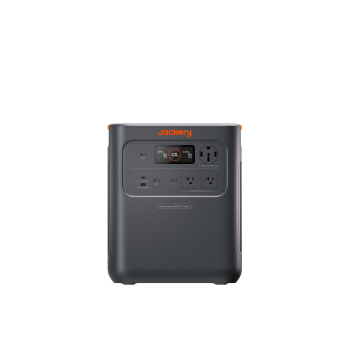
The HomePower model has more stored energy, but its 4,000W headline rating does not mean 4,000W is available to a single 120V furnace connection. This is exactly the kind of detail I would want you to understand before comparing products by name alone.
The Explorer’s capacity is close to our 2,000Wh teaching example. Its real runtime will still depend on its own efficiency and consumption, your furnace, and the installation. The larger HomePower capacity can support a longer energy budget under comparable conditions, provided the system is compatible.
Compare the complete setup cost, including any approved transfer equipment, installation, and charging equipment. The better purchase is the one that meets your confirmed load and duration requirements within your budget.
Will the furnace restart when the power goes out?
This is separate from whether the station can run the furnace once connected. Ask what the household must do when utility power fails. Is the transfer automatic, or does someone need to operate the installed equipment?
A power station’s UPS or EPS feature describes a backup operating function. It does not replace the necessary building connection or prove that your particular furnace will restart correctly. Some controls may reset or follow a restart sequence after power interruption.
Confirm output limits in the intended mode, including any AC pass-through arrangement. Also check whether an energy-saving setting could turn the station’s AC output off during a low-load period between heating calls.
Our guide to using a solar generator while charging explains why the charging source and operating mode matter. Your installer’s final test should reflect the actual outage arrangement, rather than only showing that the furnace operates while utility power is available.
Keep room in the budget for your other essentials
Maybe the furnace is your first priority, but you also want the refrigerator, a few lights, and your phone. Those loads need to fit in two places: the station’s output limits and the available energy budget.
As a simple illustration, an additional 100W average load over eight hours needs 800Wh delivered to those appliances. The battery must supply more than that after conversion losses. Small loads become meaningful when you leave them on for a long time.
Also consider appliances starting together. A refrigerator compressor starting while the furnace begins a heating cycle may produce a higher combined demand than either appliance alone.
Use our home-backup sizing guide to build the whole list, and our refrigerator runtime guide to estimate that appliance’s contribution. Give every appliance a place in the same budget.
What happens when the battery needs charging?
A fully charged station can supply stored energy after sunset. Solar panels are a way to replenish it when conditions permit; the furnace does not need sunshine at the moment it is drawing from the battery.
However, I would not assume a winter day will replace everything used overnight. Short daylight, clouds, shade, snow, panel positioning, and the station’s solar-input limits all affect what reaches the battery.
If the furnace and other loads use more power than the panels are delivering, the battery continues losing charge. Your plan needs enough stored energy, sufficient actual replenishment, or another way to stay warm when the outage lasts longer.
Check charging and operating temperature limits for the exact equipment. Keep the station in a dry, suitable location with the required ventilation and clearances. Our guide to choosing a solar-panel quantity can help you plan the charging side.
Ask for a practice run before winter
Once the system is installed, have the professionals commission it under the actual backup arrangement. A successful test should cover starting, steady operation, the period between heating calls, another restart, and return to utility power.
Ask them to include any necessary accessories and the other household loads you expect to use. Record the starting battery level, elapsed time, weather, and remaining charge so the result has context. A short demonstration proves much less than a representative operating test.
You should also leave with clear instructions for the household: what transfers automatically, what needs manual action, which loads are included, and when to change plans. If someone else is home when the outage begins, they should not have to discover those details in the dark.
Keep the furnace maintained and combustion-air and exhaust routes clear as its instructions require. Battery backup does not remove the furnace’s need for safe venting or working carbon-monoxide alarms. If you smell gas or a CO alarm activates, leave the building and contact the gas utility or emergency services from a safe location.
Questions worth answering before you buy
Is a 2,000W solar generator enough for a gas furnace?
It may be, but 2,000W describes output, not runtime or complete compatibility. Check the furnace’s operating and starting demand, the usable outlet rating, power quality, and the approved connection. Then check battery capacity separately.
Can a solar generator keep my furnace running overnight?
A properly designed system may cover your target overnight period. Calculate it using realistic heating activity, losses, reserve, and other loads, then validate the setup. The phrase “overnight backup” by itself does not tell you whether there is enough energy for a cold night.
Can I use the furnace’s BTU rating to size the battery?
For a gas furnace, the heating rating does not directly give you the electrical load. You need the electrical requirements and energy use of the operating system. Ask your HVAC professional for those figures.
Will this also work for an electric furnace or heat pump?
Those systems need their own assessment, including voltage, compressor or heating-element loads, starting behavior, and any auxiliary heat. The gas-furnace examples here do not establish a suitable battery size for them.
If your home also uses a pellet stove, use our pellet stove backup guide to work through that appliance separately. Its ignition, running, and shutdown stages need their own checks; the furnace calculation does not establish the stove’s requirements.
Build the plan around your furnace
The most useful next step is to gather your furnace model, the electrical details your technician confirms, and the number of hours you want to cover. Add the other essentials and decide what happens if the outage exceeds that plan.
Then you can compare power stations with a clear purpose. You will know whether you need more output, more stored energy, a different connection arrangement, or a larger backup strategy.
Send Grid Getaway your furnace model and backup goals, along with any installer-confirmed requirements. We can help compare the power-station specifications and capacity options while your installer confirms the furnace connection. That gives you a much stronger starting point than choosing the biggest number on the box.


