







Dinner still needs to happen when the power goes out. You might have a refrigerator full of ingredients, a family getting hungry, and a portable power station that has already been keeping a few essentials running.
A small induction cooktop seems like a useful answer. Put a pan on it, plug it into the battery, and make something hot. But before you commit to that plan, you want to know whether the power station can handle the burner—and whether cooking will leave enough energy for the rest of the evening.
I would work through those questions with you in that order. First, we will check the equipment. Then we will put a realistic cooking session into your battery budget. You do not need to become an electrical expert to make a good decision.
Can a portable power station run an induction cooktop?
Yes, a compatible portable power station can run a portable induction cooktop when its AC output meets the cooktop’s electrical requirements and its battery has enough usable energy for your cooking session. For a 1,800W countertop burner, a station with 2,000W or more of rated continuous AC output is a reasonable starting point to investigate. The exact outlet, operating mode, other loads, and both manufacturers’ instructions still matter.
The word “portable” covers very different products. A battery that is excellent for phones and lights may have neither the output nor the capacity for cooking. Equally, an impressive surge-watt figure does not mean the station can supply that much power throughout dinner.
This guide focuses on portable, single-burner, 120V induction cooktops used with compatible US power stations. A built-in cooktop or full-size range may require 240V, a dedicated circuit, and a completely different backup arrangement. Its connection needs its own assessment.
Start with the burner you actually own
Before looking at batteries, find the cooktop’s model number and electrical label. Take a photo if that makes the numbers easier to keep track of. I would want its voltage, frequency, maximum power or current requirement, and instructions for the electrical connection.
For example, the Duxtop 9600LS manual specifies a 120V, 60Hz supply on a 15A circuit and lists power up to 1,800W. It also calls for a dedicated outlet. Those details give you a specific electrical requirement to check against the station.
You may have a lower-power burner, a different regional version, or a model with a documented power-limiting control. Use that exact model’s information. A similar-looking cooktop online is not enough to establish what yours needs.
Check your pan at the same time. Induction heats compatible cookware through a magnetic field, so the pan is part of the system. Look for induction compatibility, a suitable flat base, and the size required by the cooktop. A magnet sticking firmly to the bottom is a useful first check; it does not replace the manufacturer’s cookware requirements.
That small check can save a frustrating evening. A pan the burner cannot recognize will not start heating just because you bought a bigger battery.
Two numbers tell you two different things
Power-station listings can look like a wall of numbers. For this decision, I would begin with watts and watt-hours.
Watts tell you whether the station can run the cooktop
Watts, written as W, describe power at a particular moment. A cooktop drawing 1,800W needs a source that can supply that load for as long as it continues.
The station’s rated continuous AC output is the number to compare first. Its inverter is the part that turns battery power into household-style AC electricity. The inverter and outlet must suit the cooktop’s requirements, including voltage and frequency.
Short-duration surge capacity serves a different purpose. A station rated for 1,500W continuously does not become a suitable source for sustained 1,800W cooking because its advertisement also mentions a 3,000W surge rating.
Also check everything else drawing from the station. In a hypothetical setup, a 1,800W burner plus another 900W load would demand 2,700W before considering any additional startup requirements. That exceeds a 2,200W continuous rating. Separate sockets do not create separate pools of inverter capacity.
Watt-hours tell you how much cooking fits in the battery
Watt-hours, written as Wh, describe energy. They help answer the next question: how long can the station supply the power you need?
A useful calculation is:
Energy used in Wh = average electrical watts × minutes ÷ 60.
A hypothetical 1,800W draw for 10 minutes uses 300Wh at the appliance. Maintaining that same draw for 30 minutes uses 900Wh. The power requirement is unchanged, but the longer session needs three times the energy.
Battery capacity and inverter output therefore deserve separate checks. A 1,000Wh battery could be paired with an inverter that handles your burner, or one that cannot. The capacity number alone cannot answer the compatibility question.
If this battery also needs to cover a broader outage plan, our home-backup sizing guide walks through adding the rest of your household essentials.
Does turning the heat down let you use a smaller station?
Possibly, with the right equipment and a documented electrical limit. I would be careful about treating a low heat setting as proof.
A temperature setting describes the cooking result the appliance is trying to maintain. It does not necessarily specify the highest electrical power the appliance will request along the way.
GE Appliances explains that induction control can combine variable power with on-and-off cycling at lower levels. The behavior depends on the equipment; it is not a reason to assume every portable burner uses the same pattern.
Here is why that distinction matters. Imagine one load drawing a steady 600W. Now imagine another drawing 1,800W for one-third of the time and zero for the rest, ignoring standby consumption for this simple example. Both average 600W over the complete cycle. The second still needs a source that can handle its 1,800W on-periods.
Different power requirement.
There are cooktops with a separate wattage control. The Nuwave PIC Flex model 30537 manual, for example, lists 600W, 900W, and 1,300W selections separately from its temperature controls. That is a specific feature you can investigate; it should not be assumed for another model.
If you want to rely on a lower power limit, confirm how it works, what happens at startup or after a reset, and whether the manufacturer approves the intended supply. For a straightforward backup plan, I would choose equipment that handles the burner’s maximum documented demand. That gives everyone using it a simpler setup.
Your power station’s display can help you observe operation, but a changing display or a short successful test does not prove that every brief demand was captured.
Let’s put one cooking session into the battery budget
Instead of asking how many hours a burner can run at full power, let’s start with the cooking you want to finish.
For this planning example, assume a compatible 1,800W cooktop uses:
- 1,800W average electrical input for 10 minutes during the initial heating stage.
- 600W average electrical input for 20 minutes during a lower-demand stage.
These are assumed electrical readings, not results from a cooking test or a promise that a particular meal finishes in 30 minutes. The lower-demand average also does not establish the instantaneous power needed during that stage.
| Stage | Average input | Time | Energy at the cooktop |
|---|---|---|---|
| Initial heating | 1,800W | 10 minutes | 300Wh |
| Lower-demand cooking | 600W | 20 minutes | 200Wh |
| Total | Varies | 30 minutes | 500Wh |
The cooktop receives 500Wh in this example. The battery needs to supply more because converting and delivering electricity uses some energy too.
Assume 90% overall delivery efficiency for this session, including the station’s operating overhead. This is a calculation assumption, not a measured efficiency claim for a Jackery model. We will not add a second overhead allowance on top of it.
500Wh ÷ 0.90 = about 556Wh taken from the battery.
That is the number I would carry into the rest of the household plan. The 500Wh describes energy delivered to the cooktop; approximately 556Wh is our battery allowance.
Give the assumption some breathing room. If overall efficiency were 85% instead, that session would require about 588Wh. If cooking also takes longer, the difference grows. An extra 15 minutes averaging 600W adds 150Wh at the cooktop, or about 167Wh from the battery under our 90% assumption.
Your portion size, starting water temperature, pan, cooking method, and time spent keeping food warm all affect the actual session. Once you have a compatible setup, observing a meal you regularly make is much more useful than assigning one fixed “watts per dinner” number to every household.
What is left for the rest of the evening?
Now let’s use the 1,536Wh nominal capacity of the Jackery Explorer 1500 v2 as an example. Assume it starts fully charged, we use the approximately 556Wh cooking allowance above, and we keep 20% of nominal capacity as a planning reserve.
The reserve is our chosen cushion. It is not a manufacturer-required minimum or a substitute for allowing for battery age and operating conditions.
- Starting nominal battery energy: 1,536Wh.
- Cooking allowance: about 556Wh.
- Energy remaining after cooking: about 980Wh.
- Our 20% reserve: about 307Wh.
- Energy available above that reserve: about 673Wh.
That final 673Wh is still battery-side energy. It is not automatically 673Wh delivered to appliances. Their conversion losses and any time the inverter stays on also belong in the next part of your budget.
Now suppose the same station is already at 60% when you start dinner. Using nominal capacity as a rough planning estimate, it begins with about 922Wh. The identical cooking session leaves about 366Wh, with only about 59Wh above the same reserve.
The burner has not changed. Your dinner has not changed. The starting charge has changed what you can reasonably expect afterward.
This is why I would check the battery before deciding on the meal. At 40% starting charge, this example does not fit while preserving our 20% reserve. A display percentage is an estimate, so I would not plan a session that depends on the last few predicted watt-hours.
If refrigeration is one of your priorities, put its remaining energy needs alongside dinner before allocating the battery. Our guide to solar-generator refrigerator runtime explains how to work with a refrigerator’s actual energy use. Equipment with critical power needs deserves its own dependable plan.
Which Jackery size would I consider?
For an 1,800W portable burner, I would compare two separate things: how comfortably the rated output covers the load, and how much battery capacity remains after cooking.
The US versions below are examples to evaluate, not a blanket approval for every induction cooktop. These output figures describe rated battery operation, with no other loads and within the manufacturer’s operating limits.
| Power station | Nominal capacity | Rated AC output | What the difference means |
|---|---|---|---|
| Jackery Explorer 1500 v2 | 1,536Wh | 2,000W | 200W between an 1,800W load and the rated output; assess the remaining evening’s energy carefully. |
| Jackery Explorer 2000 v2 | 2,042Wh | 2,200W | 400W between that load and the rated output, with more stored energy for the rest of the plan. |
Specifications are from Jackery’s Explorer 1500 v2 / JE-1500D manual and Explorer 2000 v2 / JE-2000D manual. The 1500 v2’s 2,000W rating applies from 14°F to 113°F; its listed output is lower below that range. Check the limits for your conditions and exact unit.
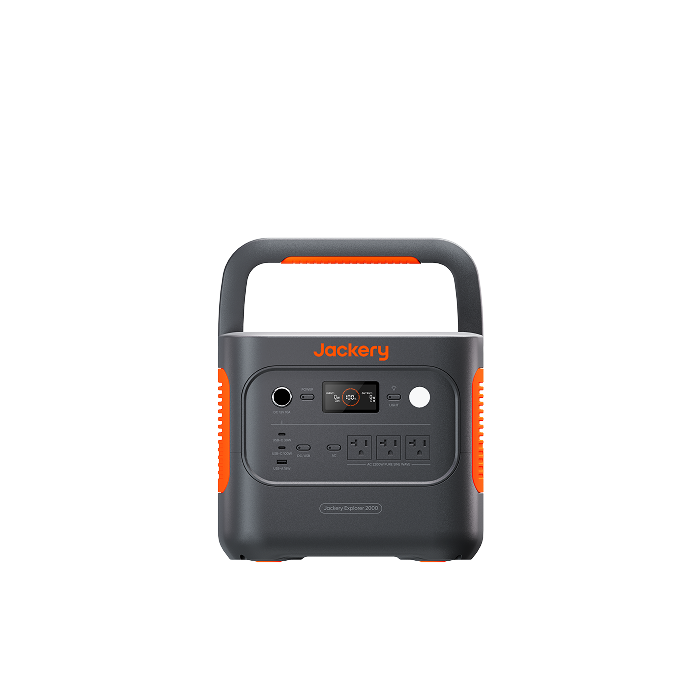
2,200W rated AC output
Check the burner and operating mode.
With the same cooking allowance, full starting charge, and 20% reserve, the 2000 v2 would have about 1,078Wh of nominal battery energy left above the reserve. Compare that with approximately 673Wh for the 1500 v2. Neither figure is a tested runtime, but the difference helps explain what extra capacity buys you.
I would not turn the spare output watts in the table into an automatic invitation to add another appliance. The cooktop’s connection instructions, individual outlets, other loads, and their startup behavior still apply. For the first cooking check, keep the burner as the only load.
If your plan is one short meal and a few modest essentials, that is a different purchase from cooking several times between recharges while also supporting refrigeration. Choose for the whole interval you need covered.
Check the rating again if the station is plugged into the wall
This is an easy detail to miss. Battery operation and AC bypass operation can have different limits.
The Explorer 1500 v2 manual lists a 1,440W maximum AC output in bypass mode, compared with its 2,000W rated battery output in the specified temperature range. An 1,800W burner exceeds that bypass limit.
That means plugging the station into a wall outlet while cooking is not automatically equivalent to running the burner from its battery. Follow the instructions for the exact operating mode; do not assume charging increases the available appliance output.
For a fuller explanation, see our guide to using a solar generator while charging. Check its charging source, too: AC wall charging and solar charging do not necessarily use the same electrical path.
Will solar panels keep up while you cook?
I would treat solar as part of your recharge plan and budget the cooking session from stored energy first.
A panel’s advertised wattage is not a promise of continuous input at your station. Sunlight, placement, shading, panel compatibility, and the station’s input limits all affect what gets through. At dinner time, you may have little or no useful solar production.
For a simple recharge illustration, suppose your compatible panels provide an average of 300W at the station’s input, its appliance outputs are off, and 90% of that incoming energy is stored after charging losses and overhead. That would add approximately 270Wh per hour.
Replacing the example’s roughly 556Wh cooking withdrawal would then take about 2.1 hours at those assumed conditions. That is equivalent time at a sustained average input, not a forecast that any two daylight hours will do it. Clouds, lower sun, or additional loads change the result.
If you cook while solar charging, some incoming power may reduce the battery withdrawal. Use the manufacturer’s supported arrangement and the observed input and output. A charging symbol by itself does not mean the battery is gaining energy.
Our guide to how many solar panels you need helps connect that recharge requirement to the wider plan. For a weekend away, include every meal and overnight load before counting on the next charging window.
Make the cooking setup work in the real space
Once the numbers fit, imagine yourself actually using the setup. Where does the pan sit? Where does the battery go? Can you reach the controls without stepping over a cord?
Choose the location allowed by both manuals. Keep the power station away from burner heat, steam, spills, and blocked ventilation. Give the cooktop its required clearances on a suitable stable surface. Keep cords clear of the hot pan and routes where someone could pull the appliance over.
For the Duxtop example, the manual specifies a dry, level, nonflammable, nonmetallic surface and at least four inches of ventilation space. It also explains that the cooling fan continues after cooking. Let the equipment complete its normal shutdown and cooling sequence.
Portable does not automatically mean approved for outdoor use. The Nuwave PIC Flex 30537 manual expressly says not to use it outdoors. If your plan is campsite cooking, choose equipment and a location whose instructions support that use. Our RV power guide can help with the wider trip budget, but it does not override an appliance’s placement limits.
For the connection, start with the appliance’s own cord and a suitable station outlet as permitted by the instructions. If an extension is necessary, check both manuals before selecting it; our extension-cord guide explains the ratings and length questions. Keep the cooktop’s outlet dedicated as instructed.
Battery power also leaves the usual cooking responsibilities in place. The U.S. Fire Administration’s cooking guidance emphasizes attending the pan, turning the burner off when you leave the kitchen, and keeping combustible items away from the cooking area. Induction cookware and the surface beneath it can remain hot after cooking.
Do a practice meal before you depend on it
You will learn more from one properly planned cooking session with your actual equipment than from another page of generic runtime claims.
Once compatibility is established, I would make a familiar meal while normal power is available as a fallback. Use the intended cookware, portions, and settings, with the station operating in the mode you plan to use during an outage.
- Record the starting charge. Note whether the station is warm, cold, or already supporting other equipment. Begin the compatibility check with the cooktop alone.
- Watch the operation. Check whether the cooktop works normally across the settings you intend to use and whether the station reports an overload or temperature warning. Follow the manuals if a fault occurs; do not repeatedly force restarts.
- Record the full session. Include heating, cooking, any keep-warm time, and the normal cooling sequence. Note the ending charge and any available energy-use information.
- Compare the result with your plan. Allow for changing conditions and battery age. A successful session is useful evidence for your setup, not a guarantee for every future meal.
A properly rated plug-in energy meter can measure energy delivered to the cooktop if the equipment instructions permit it. Its kWh reading multiplied by 1,000 gives Wh. You still need to account for the station’s losses when translating that appliance-side measurement into a battery allowance, and an energy total does not establish peak power compatibility.
If the meal takes much more energy than expected, adjust the plan while it is easy. You could choose a shorter cooking task, prepare ingredients ahead, or budget more capacity. If you mainly need to reheat portions, our microwave backup guide gives you another option to evaluate by its input power and actual session energy.
Questions you may still have
Will a 2,000W power station run an 1,800W induction cooktop?
It can be a suitable candidate if 2,000W is its continuous AC rating in the mode you are using, the outlet and electrical characteristics match, and the manufacturers’ requirements are satisfied. Keep other loads within the shared limits. You still need enough usable battery energy for the cooking session.
Can a 1,000Wh battery run an induction cooktop?
Possibly. First check its inverter output; 1,000Wh is an energy-capacity figure. If the output is suitable, our illustrative session would withdraw about 556Wh under the stated assumptions. Starting full would leave about 444Wh before reserving energy for later. Starting partly charged changes that answer significantly.
Does the cooktop need to stay at full power?
No. Your cooking process may use several settings and varying electrical demand. Size the supply for what the appliance can actually request, then calculate session energy from the average demand over time. A lower heat setting is useful only if it still cooks the food properly and the electrical setup remains compatible.
Can I plug an induction cooktop directly into a solar panel?
A household AC cooktop needs an appropriate AC supply. A standard portable solar panel provides DC electricity and is not a direct substitute for that supply. In the arrangement discussed here, compatible panels connect to the station’s approved solar input, and the cooktop connects to its suitable AC output.
Choose for dinner—and what comes afterward
I would start with your actual burner and the meal you want to make. Confirm the electrical match, estimate the complete cooking session, and leave enough energy for the things you need afterward.
That turns a vague question about whether a solar generator can cook into a plan you can check: this cooktop, on this station, starting at this charge level, with this much energy set aside for the evening.
If you are comparing options, keep the cooktop model, its electrical label, your expected cooking time, and your other essential loads together. Those details will help us work through the right Jackery size with you—and help you feel comfortable using it when dinner cannot wait.


