







That freezer might hold weeks of groceries, meals you prepared ahead of time, or the last of your garden harvest. When the power goes out, you want to know whether everything inside will still be frozen tomorrow.
A portable solar generator can help, but I would not choose one by looking at the biggest wattage on the box. I would start with your freezer, the hours you want covered, and how you will check that the food stays at the right temperature.
We can turn those questions into a practical plan. You do not need to become an electrician or memorize battery specifications. You need a few useful numbers, equipment that works together, and a test before an outage leaves you depending on it.
Can a solar generator run a freezer?
Yes. A solar generator can run a compatible freezer if its AC output can handle the freezer’s operating and startup demands, and its battery holds enough usable energy for your backup period.
In this guide, “solar generator” means a portable power station that can charge from compatible solar panels. The battery runs the freezer when sunlight is unavailable. You can also begin an outage with a battery charged from a wall outlet; panels are not required for that stored energy to work.
The answer for your particular freezer depends on its model, actual energy use, and operating conditions. “It can start my freezer” and “it can keep my freezer running for two days” are separate questions. We need to answer both.
Before the battery, get a temperature reading
I would put an appliance thermometer on the shopping list alongside the backup equipment. The power station can tell you about its charge level. It cannot tell you whether the food in your freezer stayed cold enough.
The FDA recommends keeping your freezer at 0°F or below and having an appliance thermometer in it before a power emergency. That gives you a useful baseline while everything is working normally.
Write down where your freezer usually sits temperature-wise, then keep the door or lid closed as much as possible during an outage. If you use a remote temperature sensor, check whether its display or alerts need your home network to work. A monitoring system that loses its connection when the router turns off needs its own backup plan.
Which freezer are we actually backing up?
A small chest freezer holding a few weeks of meals is a different planning job from a large upright freezer in a hot garage. The cabinet’s shape is useful context, but it does not give us a dependable runtime by itself.
ENERGY STAR’s freezer guidance explains that chest freezers are usually more energy efficient than upright models, and that manual defrost can reduce energy use compared with automatic defrost. Those are general comparisons. Your model and the way you use it still matter.
I would note three things before looking at batteries:
- The exact model: photograph its label and find its manual or energy information.
- The defrost arrangement: a frost-free appliance may have operating periods that a short measurement misses.
- The location: record the room or garage temperature during your measurement, and check the freezer’s permitted ambient range.
A cool-weather measurement may not represent a summer outage in the same garage. Likewise, measuring an empty freezer just after switching it on answers a different question from measuring one already holding frozen food at its normal setting.
Use the conditions you are preparing for as closely as you reasonably can. If the freezer’s documentation does not support its current location, choosing a larger battery will not resolve that installation problem.
Keep these three numbers separate
Here is the simplest way I know to make freezer sizing less confusing:
| Number | Question it answers |
|---|---|
| Operating power, in watts | Can the station supply the freezer while its compressor or other equipment is operating? |
| Startup demand | Can the station handle the brief demand when the compressor starts? |
| Daily energy, in Wh or kWh | How much stored energy will the freezer need over the hours you want covered? |
Watts (W) describe power at a moment. Watt-hours (Wh) count energy used over time: a device drawing 100W for one hour uses 100Wh. One kilowatt-hour (kWh) is 1,000Wh. When I talk about AC output, I mean the power supplied through the station’s household-style outlets.
A freezer does not necessarily draw its running wattage every minute of the day. Its compressor cycles, so multiplying one moment’s display reading by 24 can produce a misleading estimate.
The reverse mistake is using the daily average to choose the AC output. A freezer averaging 25W across a day can demand much more while operating or starting. The average helps with battery capacity; it does not prove that a 25W supply could run the appliance.
Check startup information with the freezer manufacturer, and match it to the station’s documented output capability. A surge rating without a compatible duration or motor-load behavior is not a complete compatibility check. Do not assume one universal startup multiplier applies to every freezer.
Find the energy number that belongs to your freezer
If you can measure, record several ordinary days
A suitable plug-in energy meter can record the electricity used over time. Use one rated for the freezer’s electrical requirements and permitted by the appliance instructions. If you are unsure about using an intermediate device, ask the manufacturer before connecting it.
Start with the freezer already cold, then record total kWh and elapsed hours through several normal days. Keep normal contents and temperature settings. Note unusual events, such as loading a large amount of unfrozen food or leaving the lid open while reorganizing.
Suppose an illustrative reading is 1.8kWh over 72 hours. That works out to:
1.8kWh ÷ 3 days = 0.6kWh per day, or 600Wh per day.
That is the number we will use in one worked example below. It is not a claim that your freezer uses 600Wh daily. A basic energy meter also may not capture a very short startup peak accurately, so do not treat its highest displayed wattage as a certified compressor-start measurement.
If you cannot measure yet, use the EnergyGuide label as a starting point
The yellow label provides an estimated annual energy figure. The FTC’s EnergyGuide explanation also tells you where to look if the label is missing, including the manufacturer’s website.
Use the number in kWh per year, rather than the estimated dollar cost. Divide by 365, then multiply by 1,000 to convert daily kWh into Wh.
to a daily energy estimate.
Check operating and startup power separately.
For example, an assumed label figure of 219kWh per year becomes 600Wh per day. That is a planning estimate from annual usage, not a guarantee for each day in your home. Replace it with a representative measurement when you can.
If the freezer is older, has a questionable seal, or lives in a difficult environment, I would be especially reluctant to buy a battery that only just meets an estimate.
What size battery would cover the outage?
Let’s stay with the illustrative freezer using 600Wh per day. Its average AC demand is 600 ÷ 24 = 25W. We also need to allow for the station converting battery energy to AC and keeping its electronics running.
For this calculation only, assume:
- 90% conversion efficiency, excluding the separate overhead below.
- 8W of station overhead while AC output remains available.
- A 20% unused battery reserve, starting from a full charge.
- No solar charging and no other connected loads.
These are teaching assumptions, not measured Jackery performance or universal values. Actual overhead and efficiency vary by unit, load, and settings.
For 24 hours, the freezer needs 600Wh at its plug. Dividing by 0.90 gives about 667Wh from the battery for that appliance energy. The assumed station overhead adds 8W × 24 hours = 192Wh.
Total modeled battery use is approximately 859Wh. Allowing the planned reserve means dividing the unrounded result by 0.80, giving about 1,073Wh of nominal capacity. Rounded upward to the next 10Wh, that becomes 1,080Wh.
more than the freezer’s Wh.
Here is how the same method changes across three hypothetical daily energy readings:
| Freezer energy per day | 12 hours | 24 hours | 48 hours |
|---|---|---|---|
| 600Wh | 540Wh | 1,080Wh | 2,150Wh |
| 1,000Wh | 820Wh | 1,630Wh | 3,260Wh |
| 1,500Wh | 1,170Wh | 2,330Wh | 4,650Wh |
All entries use the assumptions above and round upward to the next 10Wh. They describe energy capacity only. You still need suitable AC output, startup capability, temperature conditions, and operating settings.
The pattern is useful: once you know your freezer’s daily use, the required battery becomes much easier to judge. A description such as “large freezer” leaves too much unknown.
How two Jackery sizes compare under those assumptions
The Jackery Explorer 1000 v2 has 1,070Wh of nominal capacity and 1,500W rated output in its U.S. manual, model JE-1000D. The Explorer 2000 v2 provides 2,042Wh and 2,200W rated AC output according to its U.S. manual, model JE-2000D.
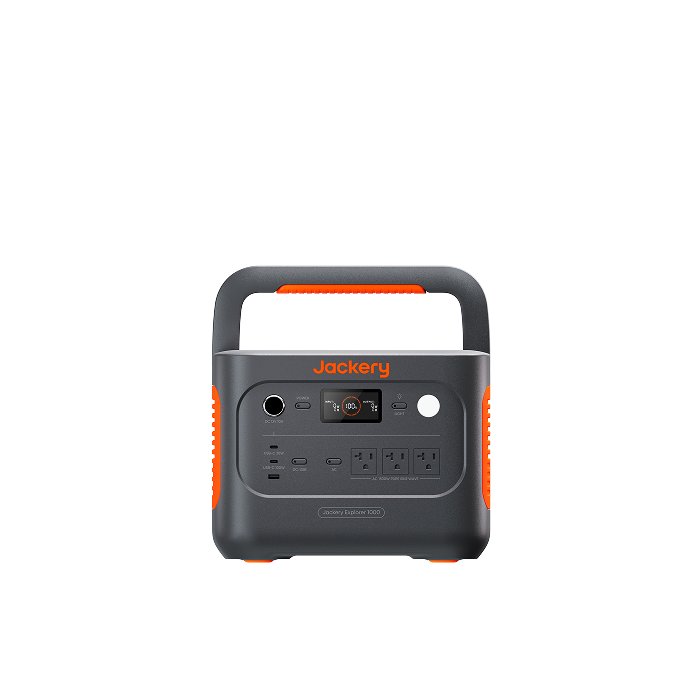
1,500W rated output
Using those nominal capacities with our same hypothetical efficiency, overhead, and reserve gives these calculated durations:
| Freezer energy per day | Explorer 1000 v2 | Explorer 2000 v2 |
|---|---|---|
| 600Wh | About 23.9 hours | About 45.7 hours |
| 1,000Wh | About 15.8 hours | About 30.1 hours |
| 1,500Wh | About 11.1 hours | About 21.1 hours |
For the 600Wh-per-day example, the calculation is:
Runtime = nominal battery Wh × 0.80 ÷ [(25W ÷ 0.90) + 8W].
The displayed decimals help you follow the calculation; they do not imply that we can predict your freezer’s runtime to the nearest six minutes. Startup compatibility must be confirmed separately.
I would treat a result of 23.9 hours as a reason to leave more room when shopping for a full-day plan. Likewise, 45.7 hours is short of a 48-hour goal with that reserve. A battery does not gain extra capacity because its product name has a larger round number.
Starting charge changes the answer too. If the 2,042Wh battery starts at 80% and you want to finish at 20%, only 60% of nominal capacity is in that window. The same modeled freezer load then gives about 34.2 hours, rather than 45.7.
Check the settings before leaving the freezer connected
The freezer can be quiet because it is satisfied with its temperature. That does not mean its power supply is no longer needed; it must be ready when the thermostat calls for cooling again.
Both linked Jackery manuals describe a default Energy Saving Mode with a 12-hour automatic output shutoff under the listed low-load conditions, including AC output at or below 25W. They also describe a separate two-hour no-charge/no-discharge standby setting, adjustable in the app.
A 25W daily average does not mean the freezer stays below the 25W threshold. Its actual cycling pattern matters. Do not assume every freezer will trigger a shutoff, or that a brief successful test proves it will stay connected overnight.
For the selected setup, review energy-saving, standby, scheduled-output, and battery-saving settings. Use the documented controls where changes are needed, then confirm operation through a representative period. Settings that reduce usable capacity need to be reflected in your runtime estimate.
If you want automatic backup while the station remains connected to wall power, check that mode separately. The manuals describe UPS switching within 20 milliseconds, recommend one connected device, and call for compatibility testing. Bypass limits can differ from battery output limits.
Our power-station versus UPS guide explains that choice. Buying a suitable battery and configuring a dependable automatic arrangement are related steps, but one does not automatically complete the other.
Battery runtime is not a food-safety countdown
This is where I would slow down, because two useful kinds of guidance can easily get mixed together.
FoodSafety.gov’s frozen-food guidance says a full freezer can hold a safe temperature for approximately 48 hours without power, or 24 hours if half full, with the door kept closed.
Those figures describe how cold food may stay inside an unpowered freezer under the stated conditions. They do not tell you how long a battery will run the appliance, and they are not guaranteed extra hours to add after any calculated runtime.
Check the temperature.
Is AC output available?
When will you recharge?
Assess food separately if cooling is interrupted.
I would not intentionally switch the freezer off for long stretches simply to stretch the battery display. Plan around maintaining the proper temperature, and use actual monitoring and official guidance if cooling is interrupted.
If food partially thaws, assess individual items using the linked frozen-food chart. Its guidance considers remaining ice crystals, temperature, time, and food type. It identifies situations where refreezing is acceptable, but there are exceptions: ice cream and frozen yogurt, for example, are listed for disposal in the thawing scenarios shown.
For frozen meat, poultry, and seafood, the chart calls for disposal after more than two hours at 40°F or above. Never taste food to decide whether it is safe. Restoring power does not establish that previously warmed food is safe to keep.
Make the equipment fit the space safely
Check where both machines will sit before the outage. The Jackery manuals require indoor use, a clean and dry environment, and adequate ventilation. A freezer approved for a garage does not automatically mean every battery is suitable for the same temperatures.
Keep the station’s vents unobstructed and give the freezer the clearances specified by its manufacturer. Avoid placing the battery in a cabinet just to hide it, beside a heat source, or where leaks could reach it. Check charging and discharging temperature limits separately.
Plan a connection using the equipment’s approved cords and instructions. If an extension is permitted, it must be suitable for the load and length; do not assume a spare household cord is acceptable. Avoid pinching cables under lids or doors, and keep plugs accessible for inspection.
A compatible freezer plugged into the station is different from powering a household circuit. If you want an installed connection, our transfer-switch guide explains the additional equipment and professional planning involved. Never feed house wiring through an ordinary wall outlet.
What happens when the outage lasts longer?
For a short outage, a charged battery may cover the job you planned. For repeated days, you need a way to replace the energy used while the freezer keeps running.
Our 600Wh-per-day example used about 859Wh from the battery each day after its stated conversion losses and overhead. Recharging has losses too. Under a separate assumed 90% overall charging efficiency, including charging overhead, replacing that energy would need roughly 954Wh supplied to the charging system.
That is why I would not size panels by comparing their advertised wattage with the freezer’s 25W daily average. Sunlight varies, nighttime still needs a battery, and the station has input limits.
As a clearly hypothetical solar budget, take a compatible 400W array and four equivalent peak-sun hours. Multiply those two numbers, then assume 75% of that energy reaches the charging input after accounting for field conditions:
400W × 4 hours × 0.75 = 1,200Wh at the charging input.
Applying the assumed 90% charging efficiency gives 1,080Wh of stored-energy equivalent. That exceeds the example’s roughly 859Wh daily battery demand, but only under those assumptions. Four peak-sun hours describe an equivalent amount of sunlight, not simply four hours on the clock.
A cloudier day can change the result. Our solar-panel sizing guide helps with that calculation, while the panel-compatibility guide covers the electrical match. Check both before buying a panel bundle.
If you already own a fuel generator, it may provide another compatible charging route. Our generator-charging guide covers the load budget, charging requirements, and outdoor generator placement. The recharge method needs its own verified plan.
Test your plan before an outage
I would rather discover a setting problem on a calm afternoon than during a storm. Begin with the freezer at its normal cold temperature and enough time to observe the equipment.
- Confirm the connection. Check the freezer and station manuals, electrical requirements, cords, placement, and startup compatibility.
- Record your starting point. Note battery percentage, freezer temperature, room temperature, and the settings you intend to use.
- Observe normal operation. Confirm the freezer starts and continues cycling without overloads or unexpected output shutoffs. Follow any specified restart delays.
- Test the intended arrangement. Battery-only use and automatic backup should each be checked if you plan to rely on both.
- Review the result. Record elapsed time, ending charge, and temperature. Extend testing sensibly toward the intended duration while monitoring the food and preserving a way to restore normal power.
Do not repeatedly force compressor restarts by rapidly unplugging and reconnecting it. A short trial confirms only what happened during that trial; a longer representative test is more useful for an overnight plan.
Keep the notes with your outage supplies. Someone else in the household should be able to identify the right outlet, settings, and next charging step without reconstructing your research.
A few freezer-backup questions worth answering
Can I run the refrigerator and freezer from the same station?
Possibly, if that operating mode supports both appliances and their combined demands. Measure each standalone appliance, add the energy, and check simultaneous operation and starting loads. A refrigerator’s built-in freezer is already included when you measure that combined appliance. Our refrigerator runtime guide includes a combined-load example.
Will a smaller chest freezer always need a smaller battery?
No. Size and style are clues, but actual daily energy and the hours you need covered determine capacity. Age, condition, settings, and surroundings can change the comparison. I would use the measurement before trusting the cabinet dimensions.
Can I save power by raising the freezer temperature?
Keep the freezer at the recommended food-storage temperature. If you need longer coverage, reduce unrelated electrical loads, start with more charge, arrange compatible recharging, or choose more battery capacity. A warmer freezer is not the outcome you are buying backup power for.
Does a solar generator work for a freezer at night?
Yes, when enough stored energy and suitable output are available. The panels recharge the battery when conditions allow; the freezer uses stored energy after dark. Work out the nighttime requirement before assuming the next sunny day solves the whole outage.
Choose the plan that fits the food you want to protect
You do not have to guess your way through this purchase. Start with the freezer model, a representative daily energy reading, and the length of outage you want covered. Check starting demand and temperature monitoring alongside the battery calculation.
Then choose equipment with room for uncertainty, configure it for the freezer’s actual behavior, and try the complete arrangement before relying on it. That is how a product specification becomes a useful household backup plan.
If you would like help comparing Jackery options, send us your freezer model, daily kWh or EnergyGuide figure, and desired backup hours. Tell us whether the refrigerator or other equipment will share the station and how you expect to recharge. We can help you compare the documented requirements with the job you need done.


