







The power is out, you’ve checked the refrigerator, and now you’re standing in the kitchen wondering whether your morning coffee is still happening.
Your power station has charge. Your coffee maker has an ordinary plug. Can you put the two together and get on with the morning?
Yes—a portable power station can run a compatible coffee maker when its AC output meets the machine’s electrical requirements and its battery has enough energy for the brewing you want to do. The important part is checking those two things separately.
A coffee maker can need substantial power while heating water, yet use a relatively modest amount of energy during a short brew. I’d rather help you match your actual machine and morning routine than tell you that everyone needs the same battery.
Start with the coffee you actually want to make
Before looking at power stations, picture a normal morning.
Do you press one button for a single mug? Brew a pot for two people? Grind beans, pull espresso, and steam milk? Each routine gives us a different job to plan for.
Write down three things:
- Your coffee maker’s exact model. A brand name alone is not enough to establish its power requirements.
- How much coffee you want. One mug, one carafe, and four separate brewing cycles are different quantities.
- How many mornings you need to cover. One outage breakfast is a smaller energy commitment than a weekend with no recharge.
If you already own a power station, have its exact model ready too. The quickest useful answer may be that your existing equipment can handle the job, or that a lower-power coffee maker makes more sense than a bigger station.
Also check what your machine means by a “cup.” The markings on a coffee-maker carafe may describe a much smaller serving than your travel mug. For battery planning, I prefer counting a defined brew or batch, with the water quantity written down.
How many watts does your coffee maker need?
Look underneath or behind the machine for its electrical label, or find the specifications in its manual. Wait until it is cool and empty before moving it.
You’re looking for input watts, voltage, and frequency. For the US examples in this guide, the relevant supply is 120V AC at 60Hz.
Two real machines show why I wouldn’t size everything from a generic coffee-maker average:
| Machine | Published US electrical rating | What that tells you |
|---|---|---|
| Capresso 5-Cup Mini Drip, model 426 | 650W, 120V, 60Hz | A station with only 500W of continuous AC output does not meet its rated requirement. |
| Breville Bambino Plus, BES500 | 1,560W, 120V, 60Hz | A 1,500W continuous-output station falls below its rating. |
Those figures come from the Capresso model 426 instructions and the Breville BES500 US manual. They describe those models, not every drip or espresso machine.
For a Keurig or another pod machine, check your specific model’s label. A compact machine still has to heat water; its small footprint doesn’t establish a small electrical load.
If the label gives only volts and amps, their product gives volt-amperes, which is not always identical to watts for an AC appliance. Use the manufacturer’s input-power specification where available, and check both the station’s wattage and outlet-current limits.
First choose enough output, then choose enough battery
The station’s continuous AC output, measured in watts, tells you how much power it can supply while the coffee maker operates.
Its battery capacity, measured in watt-hours, helps determine how many brewing sessions you can complete before recharging.
A station with plenty of stored energy can still be unable to run your machine. A 500W outlet does not become a 1,200W outlet because the battery is full.
The opposite matters too: a station may have enough output to brew successfully, but not enough remaining battery to repeat the routine every morning of your trip.
Start with a station that meets the coffee maker’s full rated requirements and any documented startup needs. I’d also leave useful output headroom, particularly when the machine sits close to the station’s limit or other loads will be connected.
If a brewer’s label says 1,500W and the station is rated for 1,500W total, that leaves no rated output margin. A model with higher continuous output gives you more room, although you still need to follow both manufacturers’ instructions.
Our home backup sizing guide takes this same approach when coffee is only one part of your household plan.
Don’t use the surge rating to cover the heating cycle
A headline surge number describes a temporary capability under the station’s specified conditions. It is not permission to run a larger heating load for several minutes.
For example, the BES500’s 1,560W rating exceeds a 1,500W continuous limit. A higher surge figure does not remove that mismatch.
Likewise, don’t assume every coffee maker needs two or three times its label wattage at startup. Check the actual appliance requirements instead of attaching an arbitrary multiplier to every machine.
What size Jackery would I look at?
Here are three current US models in our catalog, with their battery-powered AC ratings. These are specification comparisons, not claims that we have tested every coffee-maker pairing.
| Power station | Nominal capacity | Rated AC output on battery |
|---|---|---|
| Jackery Explorer 1000 v2 | 1,070Wh | 1,500W |
| Jackery Explorer 1500 v2 | 1,536Wh | 2,000W |
| Jackery Explorer 2000 v2 | 2,042Wh | 2,200W |
The ratings are documented in the US manuals for the Explorer 1000 v2, JE-1000D, Explorer 1500 v2, JE-1500D, and Explorer 2000 v2, JE-2000D. Temperature and operating-mode limits still apply.
For the 650W Capresso example, the 1000 v2 clears the appliance’s rated wattage with room remaining. Your required number of brews and other planned uses would then guide the capacity choice.
For the 1,560W Breville example, I’d move past the 1000 v2. The 1500 v2 and 2000 v2 clear that rated load when operating within the conditions for their listed battery outputs. Meeting the number is one compatibility check, not a blanket approval of every operating condition.
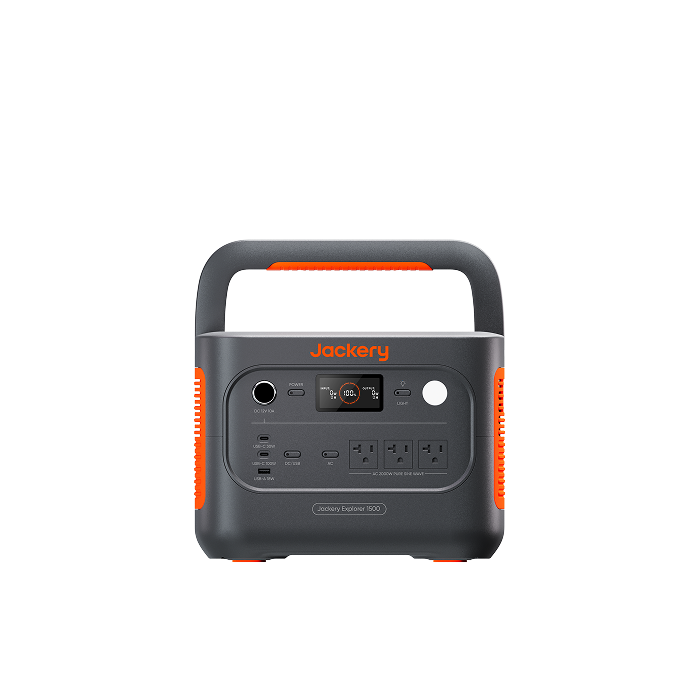
1,536Wh capacity with 2,000W rated AC output on battery within its specified temperature range.
Genuine manufacturer image. Check the separate bypass limit before using wall-powered pass-through.
You don’t need the largest option simply because it exists. Extra capacity makes sense when you want more mornings between recharges or need to share the battery with other equipment.
And don’t infer output from the product name. The Explorer 1500 v2’s rated battery output is 2,000W; the exact specification matters more than the number printed in the model name.
How much battery does one brew use?
Now we can answer the more personal question: how much of your battery does making coffee actually take?
The relationship is:
Energy in watt-hours = average input watts × operating time in hours.
Suppose a hypothetical brewing session averages 1,200W for five minutes. Five minutes is 5 ÷ 60 of an hour:
1,200W × 5 ÷ 60 = 100Wh delivered to the coffee maker.
That is an illustrative session, not a measured result for one of the machines above. A real machine’s draw can change as it heats, pumps, pauses, and dispenses.
The key is including the whole process. If you only count the seconds when coffee is flowing into your mug, you can miss the energy used before that.
For example, the Keurig K-Mini use and care guide describes a heating period before dispensing begins. Your measurement needs to start before heating, rather than when you hear coffee hitting the cup.
For espresso, include the preparation you actually do: warm-up, any rinse, extraction, steaming milk, and a separate grinder if you use one. A shot-only calculation won’t describe that whole breakfast.
The most useful number is energy per complete session
A suitably rated plug-in energy meter can help you record the watt-hours used by a compatible AC appliance. Follow the equipment instructions and stay within the meter’s voltage, current, and power ratings.
Start with the machine in its normal starting condition. Make your usual amount of coffee, include any warming time you intend to use, and record the total.
Repeat a few representative sessions. Note the water quantity, whether the machine started cold, and whether you steamed milk or brewed several drinks together.
If a meter displays kilowatt-hours, multiply by 1,000 to get watt-hours. A reading of 0.08kWh is 80Wh.
You can measure consumption from an appropriate household supply before buying a station. That measurement helps with the energy budget; it doesn’t establish compatibility with an undersized inverter.
Without a measurement, use clearly stated assumptions and leave more margin. One changing wattage reading on a station’s screen is not a complete brew-energy measurement.
How many brews could one charge provide?
Let’s turn the 100Wh example into a useful battery estimate.
I’ll assume a fully charged station, keep 20% of nominal capacity in reserve, and use an 85% overall AC delivery allowance for conversion losses and station operating energy during the sessions.
These are planning assumptions, not measured Jackery efficiencies. The estimates exclude other loads, incoming recharge, and leaving AC output on between sessions.
For the Explorer 1000 v2:
1,070Wh × 0.80 × 0.85 = 727.6Wh available for the planned AC sessions.
At 100Wh per session, that supports seven complete sessions under the assumptions. Eight would require 800Wh delivered and exceed that allocated budget.
Here’s how the same calculation changes with the energy your routine needs:
| Power station | At 50Wh per session | At 100Wh per session | At 150Wh per session |
|---|---|---|---|
| Explorer 1000 v2 | 14 sessions | 7 sessions | 4 sessions |
| Explorer 1500 v2 | 20 sessions | 10 sessions | 6 sessions |
| Explorer 2000 v2 | 27 sessions | 13 sessions | 9 sessions |
All counts are rounded down. A “session” means whatever complete routine uses the stated energy; it is not automatically one cup. These columns are hypothetical energy budgets, not assigned consumption figures for Capresso, Keurig, or Breville.
The coffee maker must also fit the station’s output rating. A promising session count cannot make the 1,560W Breville a suitable load for the 1,500W Explorer 1000 v2.
Actual results can be lower with an aging battery, different temperatures, greater conversion losses, or additional equipment. Don’t add the same conversion loss twice if your starting measurement already represents energy taken from the station’s battery.
What if the battery is only half full?
Use its starting charge, rather than giving yourself the full-capacity budget again.
If the 1,070Wh station starts at 50% and you still want to finish with 20% of nominal capacity reserved, you can allocate 30%:
1,070Wh × (0.50 − 0.20) × 0.85 = 272.85Wh delivered.
That covers two complete 100Wh sessions under the same assumptions. It’s a useful reminder to check the battery before bedtime if tomorrow’s coffee depends on it.
The warming plate can change your morning budget
You’ve brewed the coffee. Now the machine may keep using energy while the pot sits there.
The Capresso instructions, for example, describe a warming period of up to two hours before automatic shutoff. That doesn’t tell us its average warming wattage, so I wouldn’t invent one for that model.
Instead, take a separate hypothetical example: brewing uses 100Wh, then the warming plate averages 30W for one hour. Keeping the pot warm adds 30Wh, bringing the session to 130Wh.
On our 727.6Wh allocated budget, that changes the estimate from seven complete 100Wh sessions to five complete 130Wh sessions.
If you want coffee available for longer, you could pour the finished brew into a suitable insulated carafe and switch the machine off according to its instructions. Let the machine finish draining first, and never substitute a different vessel in the brewer unless its manufacturer permits it.
For a pod machine, use its documented shutdown controls when you’re finished. Auto-off behavior differs by model and generation; it isn’t a substitute for understanding what your own machine does.
After any required shutdown or cooldown, switch off the station’s AC output if nothing else needs it. The coffee maker turning itself off does not necessarily turn the inverter off. Leaving that output running between brews uses energy excluded from our session estimates.
Build a weekend plan around your actual drinks
Say two people each want one coffee on Saturday and Sunday. That’s four individual brewing sessions.
If you’ve measured or deliberately allowed 50Wh per session, coffee needs 200Wh delivered. Add an illustrative 30Wh for phone charging, measured at the AC charger inputs, and your total is 230Wh.
Using our 85% delivery allowance and 20% reserve:
230Wh ÷ 0.85 ÷ 0.80 ≈ 338Wh of nominal capacity.
That figure is an energy requirement only. If your coffee maker needs 1,500W, a 338Wh-capacity station with a 500W outlet still won’t do the job. You may choose a larger battery because it comes with the output capability your machine needs.
The example also contains no refrigerator, laptop, or evening entertainment. Add those separately using the same accounting approach. Our RV power-station guide helps you build that broader trip budget.
During an outage, decide what has priority before allocating energy to coffee. If the same station keeps food cold, work that requirement into the plan using our refrigerator runtime guide.
Make breakfast one appliance at a time when needed
Several outlets on a station usually share its total AC output limit. They don’t each provide the headline wattage independently.
A hypothetical 1,500W coffee maker and a microwave drawing 1,200W at its input would demand 2,700W together. That exceeds the 2,200W battery-powered AC rating of the Explorer 2000 v2.
Each appliance might fit individually, yet overload the station when used together. Making coffee first and heating breakfast afterward can avoid that simultaneous demand, provided each appliance is compatible on its own.
Check the microwave’s electrical input, rather than its advertised cooking output. Our microwave power guide explains that distinction.
Respect appliance instructions about dedicated supplies too. The K-Mini guide calls for its own grounded outlet and a separate circuit. Available station headroom does not override those instructions or make a shared power strip appropriate.
Check the operating mode if the station is plugged into the wall
There’s a detail I’d check before leaving the coffee maker connected to a station that is also charging from household AC.
Some stations use bypass mode, passing incoming wall power to the appliance. The permitted output can differ from the station’s battery-powered output.
The Explorer 1500 v2 manual lists 2,000W on battery within its specified temperature range, but only 1,440W maximum AC output in bypass. A hypothetical 1,500W brewer exceeds that bypass limit, even though it falls below the battery-output rating.
Check the exact model and mode you intend to use. Don’t assume that plugging the station into the wall gives the appliance more available power. Our using a solar generator while charging guide covers that wider planning question.
The earlier brew estimates assume battery-powered operation with no incoming charge. They are not pass-through or UPS performance claims.
Keep the setup suited to the place you’re using it
A battery makes power portable. It doesn’t change a household coffee maker’s permitted operating environment.
Both the Capresso and Breville manuals above prohibit outdoor use; Breville also prohibits use in moving vehicles or boats. For travel, choose equipment and a location that follow the appliance instructions. Don’t assume a picnic table becomes a suitable location simply because you have a power station beside it.
At home, use a stable, dry surface and keep the station clear of the sink, steam, hot surfaces, and possible spills. Leave its ventilation openings unobstructed.
Keep the original plug intact. If an extension cord is permitted, it must meet the appliance’s requirements, including grounding where required, and be arranged so nobody can pull hot equipment off the counter. Our extension-cord guide explains the selection checks.
If the station trips or the machine behaves abnormally, stop and check the load, charge level, operating mode, temperature, connections, and displayed fault. Don’t keep resetting it or bypass protection to force a brew.
A few questions you might still have
Will a Jackery 1000 run a Keurig?
Check both full model names. The Explorer 1000 v2 listed here has 1,500W rated output, but “Jackery 1000” and “Keurig” each describe more than one product. If your brewer itself is rated at 1,500W, there is no output margin on that station. I’d consider a higher-output option for more room and verify the intended operating mode.
Would a low-wattage coffee maker use less battery?
It may make the output requirement easier to meet. It does not automatically use less energy per finished drink. A lower-power heater running longer can consume similar watt-hours. Compare the complete session and serving size, rather than just the biggest number on the label.
Is a kettle and French press a better option?
It can suit your routine, but include the energy and output needed to heat the water. A manual brewer doesn’t remove that step, and an electric kettle may still need substantial AC power. Heat only the quantity you need within the kettle’s permitted fill range. If you’re considering an induction burner instead, our induction cooking guide covers that load.
Can solar panels power the coffee maker directly?
For the ordinary household machines discussed here, use the station’s compatible AC output. Connect approved panels to the station’s charging input. The battery helps bridge the difference between variable solar input and the coffee maker’s demand; suitable sunlight can replace energy between sessions. Our solar panel sizing guide helps you plan that recharge.
Can I recharge between mornings while driving?
Potentially, with a compatible charging setup and enough driving time. Work from actual accepted charging power, rather than assuming a short drive restores a large battery. Our car-charging guide explains what to check.
Choose the setup that gets your morning done
I’d start with your coffee maker’s label, choose enough continuous output, and then build the battery budget around complete brewing sessions.
One person making a single mug has a different plan from a family keeping a pot warm or someone making several milk drinks. A measured session, a realistic number of mornings, and some reserve make that choice much easier.
If you want help comparing Jackery options, bring us the coffee maker’s exact model, its electrical rating, the station you already own if applicable, and the routine you want to cover. Those details let us work toward a setup that fits your morning.


