







Your power station has been sitting in the garage since summer. Now a winter storm is coming, and you’re wondering whether it’s ready.
You remember charging it before putting it away. The solar panels are folded up nearby. In theory, you have backup power. But the garage is cold, the forecast looks gray, and keeping your phone charged suddenly feels less important than keeping the furnace and refrigerator working.
I’d check that setup before the lights go out. A winter backup plan has a few moving parts, and the most useful question is bigger than whether solar panels work when it’s cold: can your whole system supply the power you need, then recover enough energy to do it again?
Do solar generators work in winter?
Yes, a solar generator can work in winter when the power station stays within its operating limits and has enough stored energy for your appliances. Solar panels can generate electricity in cold weather, but winter sunlight, shade, and snow affect how much energy you collect.
The battery introduces a separate question. A station may be allowed to run appliances at a temperature where its manual does not allow charging. Storage limits can differ again.
That’s why I wouldn’t choose a winter setup from a single “works down to” temperature. Let’s walk through what you already own, where you’ll use it, and what happens after the first night.
First, separate the three jobs in your setup
A solar generator usually combines a battery power station with compatible solar panels. You can place and use those components differently, within their instructions.
I’d break the winter plan into three questions:
- Can the panels collect energy? They need usable light and an appropriate outdoor setup.
- Can the battery accept that energy? Its charging temperature, input limits, and operating condition matter.
- Can the station power your appliances? Check its discharge temperature, output capability, and remaining charge.
All three need to line up for a useful solar recharge. A sunny yard doesn’t help much if the battery is too cold to accept power. A comfortable indoor battery doesn’t refill itself if the panels are buried in snow.
You can still use previously stored energy without sunlight. That is what gets you through the evening, overnight, and periods when putting panels outside would be impractical.
Before plugging it in, check the station in your garage
Start with the exact model name on the unit. Similar names can belong to products with different batteries, temperature limits, and charging behavior. Explorer 1000 v2 and HomePower 1000 v2, for example, are separate models.
Find the current manual for your model and region. Look for charging temperature, discharging temperature, and storage. Discharging simply means using energy from the battery to run something.
The weather app isn’t measuring the battery
A forecast tells you about outdoor air. Your garage may be warmer or colder than you expect, and a station that has spent the night there will not instantly warm through when you carry it indoors.
Give yourself time to move it to a suitable dry location before the outage. Follow the manufacturer’s instructions for temperature warnings and recovery. If the unit is damp or develops condensation after the move, wait until it is dry and within the permitted conditions before connecting it.
I wouldn’t promise a universal warming time. A small station and a large battery pack do not necessarily warm at the same rate, and the starting temperature makes a difference.
A full-looking battery still needs a readiness check
Check the charge level, output settings, cables, and any warning indicators. Confirm that the devices you intend to use will actually start.
If you have expansion batteries, include them in the check. Look up their temperature limits and connection instructions too. A warm main unit doesn’t establish that an expansion battery stored elsewhere is ready.
Do this while there’s time to recharge from an approved source and resolve problems. Finding a missing cable or a disabled AC output is much less frustrating on a normal afternoon.
How cold is too cold? Compare the actual model limits
Here are three examples from Jackery’s U.S. manuals. These are operating ranges, not promises of unchanged runtime or full charging speed throughout the range.
Can it charge?
Sources: the official manuals for the Explorer 1000 v2, Explorer 5000 Plus, and HomePower 3600 Plus.
There’s an important qualification for the Explorer 5000 Plus: its manual specifies a reduced output of 3,600W from 5°F to 14°F (−15°C to −10°C). Its usual total output rating should not be assumed across that colder band.
What those numbers mean in a 20°F garage
Suppose the equipment has settled at about 20°F, or −7°C. That is within the listed discharge ranges of all three examples, but below the charging minimum for the Explorer 1000 v2 and Explorer 5000 Plus.
For those two models, being able to power a lamp in that garage would not establish that you can recharge the battery there. The HomePower 3600 Plus lists a wider charging range, but you still need to follow its instructions and account for temperature-related changes in charging power and capacity.
I’d use that comparison to narrow the buying decision. If your station will live in a temperature-controlled room, a very low charging minimum may matter less than capacity, output, or portability. If your intended location regularly freezes, the temperature specification becomes a central requirement.
Does self-heating solve the problem?
If a product advertises battery heating, ask what makes that feature operate. Does it need an external charging source? Is there a minimum input or battery level? Must you enable a setting? How much time and energy does warm-up require?
Use the answers for that exact model. A cold-weather rating alone does not tell you how the manufacturer achieves it, and you shouldn’t infer that every station with LiFePO4 cells has a heater.
Keep heating energy in the overall plan when it applies. Power used to condition a battery is another demand on the system, and a small amount of available solar input may not translate into the refill you expected.
Storage temperature is a different decision
“Can I use it outside briefly?” and “Can I leave it in the shed until spring?” deserve separate answers.
The HomePower 3600 Plus manual makes this especially clear. It lists storage ranges of −4°F to 113°F for one month, 32°F to 113°F for three months, and 32°F to 77°F for twelve months. Its broader operating range is not permission to ignore storage duration.
For your station, follow both the storage temperature and maintenance instructions. A unit put away nearly empty may not be ready when needed. A recommended storage charge level also serves a different purpose from the charge you want available before a forecast outage.
I’d give the battery a permanent place on your seasonal preparation list: inspect it, check its charge, review the settings, and confirm that the storage location still fits the manual.
If you want to understand how storage and everyday use affect ownership over several years, our guide to how long solar generators last goes further into that decision.
Where I’d put the battery and panels during a winter outage
For the indoor-rated stations discussed here, plan a dry indoor location with the manufacturer’s required ventilation and clearances. Put the solar panels in their approved outdoor operating conditions when it is safe to deploy them.
Picture the full route between those two locations before buying an extension cable. You need suitable connectors, polarity, voltage and current ratings, and a cable length the equipment can support. Protect cables from door edges, foot traffic, water, and damage.
A partly closed window pinching a cable is not a finished setup. If your charging route requires a permanent building penetration or an electrical installation, have the appropriate professional plan it.
I also wouldn’t wrap an operating station in blankets or seal it inside a makeshift insulated box. Keeping it within its temperature range still includes allowing the airflow it needs. Avoid direct heat from radiators, fireplaces, or improvised heating devices.
Keep checking that location during a prolonged outage. A room that was comfortable when the power failed may cool considerably if the heating stops. Being indoors doesn’t automatically keep the battery above its charging minimum for the whole event.
A panel’s weather-resistance rating does not apply to the power station beside it. Check each component, including connectors. A product photo of equipment outdoors is not a substitute for its operating instructions.
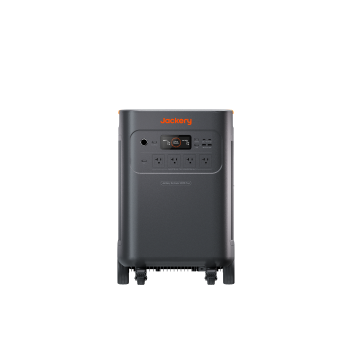
Keep the power station in its permitted environment. Check battery temperature separately from the weather around your solar panels.
For installed household loads, sort out the connection before winter. Our solar generator transfer-switch guide explains the choice between powering plug-in appliances and supplying selected home circuits.
Cold panels can work well, while the winter day produces less energy
This sounds contradictory until you separate efficiency from the amount of sunlight available.
Solar cells generally perform more efficiently at lower temperatures under otherwise comparable conditions. The Department of Energy explains the temperature effect in its solar performance and efficiency guide.
But a panel can only convert the light that reaches it. A shorter day, a lower sun angle, cloud cover, and shading can reduce the energy collected across the day even when the cells themselves are cool.
Think of a clear winter noon when the display looks encouraging. That reading tells you what is happening then. It does not establish that the station received the same input for the previous four hours or will keep receiving it until sunset.
Look at the winter sun from your actual panel location
A spot that worked in July may spend much of December behind the house or a neighboring roofline. Check where sunlight reaches the panels at different times, within a placement you can safely maintain.
Use the panel’s supported stand or mounting arrangement to orient it toward available sunlight. Keep the setup stable in wind, and don’t count on moving equipment across icy ground throughout the day.
For sizing, use winter conditions for your location and intended layout. A summer charging result or an annual average is a weak basis for deciding whether your next winter night is covered. Our solar panel sizing guide explains how daily energy needs translate into a panel plan.
Treat snow and ice as an access and equipment problem
The Department of Energy’s winter-weather guidance for solar systems explains that snow and ice can limit production and place stress on equipment.
For portable panels, follow their cleaning, temperature, and handling instructions. Avoid scraping the surface with sharp tools, pouring hot water over it, or forcing frozen hinges and cables. If safe access or deployment isn’t possible, leave solar generation out of the immediate backup budget.
Don’t climb onto a snowy roof to rescue an energy estimate. Fixed rooftop systems need their own maintenance plan, and rooftop panels do not automatically become a charging source for a portable station.
One further compatibility check matters in cold weather: panel open-circuit voltage can rise as cell temperature falls. Have the manufacturer or installer check the array’s cold-weather voltage against the station’s maximum input, especially when panels are wired in series. A combination that sits close to the limit on a mild day deserves review before winter.
Let’s work through a winter night, then the following day
Here’s the part I’d spend time on with you before choosing a battery. Getting through tonight is useful. Knowing what remains tomorrow helps you decide whether the setup matches your expectations.
We’ll use a hypothetical 5,000Wh battery in a suitable indoor environment. This is an invented planning example, not a test of a Jackery model or a claim about a typical home.
Our assumptions are:
- The battery starts at 90%, or 4,500Wh.
- We want to preserve a 10% reserve, or 500Wh.
- AC conversion delivers 90% of the energy allocated to appliances.
- Separately, we allow 15W for the station’s own continuous consumption.
- The twelve-hour overnight window runs from 6 p.m. to 6 a.m.
The 90% conversion assumption excludes the separate 15W overhead in this example. Actual efficiency and overhead vary by model and load. We are not applying an invented universal cold-weather capacity deduction; the battery is already in an appropriate indoor environment.
Step 1: Add up the appliance energy
| Appliance | Assumed use | Energy |
|---|---|---|
| Refrigerator | 60W average across 12 hours | 720Wh |
| Compatible gas-furnace electrical load | 400W while running, for 3 hours total | 1,200Wh |
| Router | 10W for 12 hours | 120Wh |
| LED lighting | 18W total for 4 hours | 72Wh |
| Phone charging | Combined allowance through AC chargers | 40Wh |
| Total | Energy delivered to appliances | 2,152Wh |
Notice the difference between the refrigerator’s average draw and the furnace’s running draw. We have already accounted for cycling in the refrigerator assumption. The furnace’s three hours represent accumulated running time across the twelve-hour period.
Replace these with your own measurements or supported estimates. In particular, your furnace may need to run much longer on a colder night. Our gas-furnace backup guide also covers startup and connection requirements, which this energy table does not establish.
Step 2: Calculate what leaves the battery
Accounting for the assumed AC conversion efficiency:
2,152Wh ÷ 0.90 ≈ 2,391Wh.
Then add the station’s assumed overnight consumption:
15W × 12 hours = 180Wh.
Total battery energy used is approximately 2,571Wh. Starting with 4,500Wh leaves about 1,929Wh at 6 a.m., or roughly 39% of nominal capacity.
We made it through the first night above our 500Wh reserve. That is encouraging, but it is only half the plan.
Step 3: Include what the house uses during daylight
Suppose the next twelve hours have a lower combined appliance load averaging 90W. That gives us 1,080Wh at the appliances.
Using the same assumptions, battery demand is 1,080Wh ÷ 0.90 + 180Wh = 1,380Wh.
Now imagine the panels deliver a total of 1,000Wh accepted at the station’s solar input during that day. We’ll assume 90% becomes stored energy, adding 900Wh. This is an invented daily input total, not a forecast based on panel wattage.
By 6 p.m., the balance becomes:
1,929Wh + 900Wh − 1,380Wh ≈ 1,449Wh.
The panels worked, and the battery still ended the day lower. After preserving the 500Wh reserve, only about 949Wh remains available for the next night. Repeating the first night’s 2,571Wh battery demand would exceed that budget by about 1,622Wh.
The battery still fell.
What would a better solar day change?
If the station instead accepted 3,000Wh of solar energy, the same 90% storage assumption would add 2,700Wh. After daytime use, the battery would reach approximately 3,249Wh.
A repeat of the first night would then leave about 678Wh, just above our 500Wh reserve. That is a narrow margin. Extra furnace operation, a lower starting charge, or poorer efficiency could consume it.
To return to the original 4,500Wh before the second night while covering our assumed daytime demand, we would need approximately 4,390Wh accepted at the solar input. That follows from (4,500 − 1,929 + 1,380) ÷ 0.90, using unrounded values.
That target is useful when assessing a proposed panel setup. Compare it with what the location, season, array, and station input limits can reasonably support. Extra panel capacity alone doesn’t establish that the target is achievable.
Now change the assumption that matters most
Suppose the furnace runs for six hours that first night instead of three. Its electrical consumption rises by 1,200Wh. At our assumed conversion efficiency, that adds about 1,333Wh of battery demand.
The same starting battery would finish the first night with only about 596Wh. Almost all the room above our chosen reserve has disappeared before morning.
The timing of tomorrow’s solar input matters, too. A daily energy total doesn’t show whether useful charging begins before your remaining reserve is reached. A battery that finishes the night nearly empty may need another source or a reduced load while you wait for better light.
That is why I’d examine furnace duty time before obsessing over a few watts of lighting. The most useful winter calculation includes a demanding night as well as the easier one you hope to have.
What to change when the energy budget doesn’t work
Finding a shortfall on paper gives you choices while you can still make them calmly.
First, refine the essentials. Separate must-run equipment from conveniences you can postpone. Keep a realistic allowance for communication and lighting, and identify high-demand appliances that would alter the plan substantially.
Second, reconsider the heating approach. Supplying electricity to a compatible gas furnace is a different energy task from producing heat in a resistance heater. A 1,500W space heater running for two hours would use 3,000Wh at the appliance before battery losses. Our space-heater guide works through those limits.
Third, decide whether more stored energy solves the right problem. A larger battery or compatible expansion pack may cover a longer interruption. For repeated days, you also need a way to replace what you use.
Fourth, assess another approved charging source. Depending on your equipment and circumstances, that might mean access to utility power elsewhere, a supported vehicle charger, or a compatible fuel generator. Compare actual charging capability and source availability using our solar generator charging-time guide.
If a fuel generator is part of the plan, follow its outdoor siting instructions and keep exhaust away from occupied buildings. Never run it in the house or garage, even with the doors open. The CPSC’s portable-generator guidance explains the carbon-monoxide and electrical hazards.
Finally, decide what you will do if the outage outlasts the system. A battery should support a household plan that includes somewhere safe to go if essential heat or other critical services cannot be maintained.
Choose a station around where you will actually use it
I’d compare the temperature requirements with the rest of your needs before making a shortlist.
The Jackery Explorer 1000 v2 may be relevant to a smaller essentials plan, but its charging minimum belongs in your decision if you intend to keep it in a freezing location.
The HomePower 3600 Plus is worth examining when a wider permitted charging-temperature range is useful. That feature still needs to sit alongside the required output, battery capacity, and practical storage location.
The Explorer 5000 Plus belongs in a comparison involving larger loads and supported 120V/240V connections. Its cold-temperature output qualification shows why a bigger model is not automatically the answer to every winter-use question.
If you’re starting from an appliance list, use our home-backup sizing guide alongside the temperature comparison. Buy enough capability for the job you’ve defined, including the location where it must work.
If it won’t charge, check this before buying more panels
A low or zero input reading can have several explanations. I’d work through them in this order:
- Read the warning or status message. If temperature protection is active, follow the manual’s recovery instructions. Do not try to defeat the protection.
- Check whether charging is being requested. A full battery, configured charge limit, or charging schedule may explain the behavior.
- Check the available source. Are the panels receiving usable light? Has snow or a moving shadow covered them? For AC charging, is the approved source actually available?
- Check the supported connection. Follow the manual when inspecting cables and connections. Verify the panel arrangement against voltage and current limits; never disconnect or modify equipment contrary to its instructions.
- Compare energy coming in with energy being used. A charging symbol does not guarantee that the battery percentage will rise while appliances are running.
If the conditions are suitable and the warning persists, use the manufacturer’s support process. Repeatedly resetting the unit or adding panels won’t resolve a temperature restriction or damaged connection.
For sunlight variability specifically, our cloudy-day solar generator guide helps you interpret changing input without assuming every low reading means a fault.
Your winter preparation checklist
Before the forecast turns into an outage, I’d want these six things settled:
- The equipment: exact models, current manuals, suitable cables, and all expansion batteries checked.
- The location: dry, accessible, ventilated, and within the required temperatures.
- The load plan: what runs together, what can wait, and enough output for startup demands.
- The energy plan: the first night, a demanding-night alternative, and the next day’s consumption.
- The refill plan: realistic winter solar expectations and any other approved source you can actually access.
- The household routine: who checks the battery, what reserve prompts a change of plan, and how everyone operates the setup.
A practice run can reveal settings and loads you overlooked. Do it under suitable conditions before relying on the equipment, and record what the station uses over time. A brief successful startup is useful, but it doesn’t establish overnight endurance.
Winter questions you might still have
Can I leave a solar generator outside in the snow?
Check the power station’s own environmental rating and instructions. For the setups in this guide, keep the station in a suitable dry indoor location. Outdoor-rated panels do not give the attached battery the same protection.
Can I charge through a window instead?
Don’t assume an indoor panel behind glass will reproduce its outdoor performance. Glazing, shadows, orientation, and the available light can affect input. Follow the panel’s permitted use conditions and measure what that location actually delivers before including it in an outage plan.
How much battery capacity will I lose in cold weather?
There isn’t one percentage that applies to every station, temperature, and load. Use model-specific guidance or relevant test data. A permitted operating range is not a guarantee that runtime matches a room-temperature result.
Should I keep the station fully charged all winter?
Follow its instructions for storage or standby use. Before a forecast outage, plan the charge level you need within those instructions. Don’t apply another model’s storage percentage, charging schedule, or maintenance interval to yours.
What if my panels are producing power but the battery is dropping?
The total battery demand may exceed the energy being stored. Our worked example shows how that can happen across a whole day. Check loads, input, operating limits, and settings before concluding that the panels or station are defective.
Make the winter plan before you need the power
A solar generator can be a useful part of winter preparedness. The setup becomes much more dependable when you know where the battery belongs, when it can charge, and how much energy the household will use.
I’d start with the station in your garage, its exact manual, and the essentials you want working tonight. Then I’d carry the calculation through tomorrow. That second step is what turns a charged battery into a backup plan you understand.


